
Basalt in Cladding: Properties and Applications
Basalt in cladding is a dense, dark stone of volcanic origin: an extrusive igneous rock in grey, dark grey or almost black with a fine-grained, uniform structure. It is strong, frost-resistant, absorbs almost no water and resists abrasion, so it suits facades, plinths, steps and paving.
The key selection criterion is the finish and the uniformity of the batch: basalt colour can vary slightly between slabs, and the surface treatment determines how dark and how slippery the stone will be.
Basalt is chosen by architects of contemporary facades that need a strict graphite tone, as well as for plinths and heavily used landscaping. You can compare it with other rocks in the section Natural stone for facades and interiors.
Properties
Basalt forms when lava cools rapidly at the earth’s surface. As a result, its mineral grains (plagioclase, pyroxene, sometimes olivine and volcanic glass) are very fine, and the stone looks uniform and matt. There are porous varieties that retain gas bubbles; these are used as decorative stone.
| Parameter | Typical range |
|---|---|
| Density | about 2700–3100 kg/m³ |
| Compressive strength | approx. 100–300 MPa and above for dense grades |
| Water absorption | as a rule, a fraction of a percent |
| Mohs hardness | 5–6 |
| Frost resistance | high for dense basalt |
| Acid and alkali resistance | high |
Values depend on the deposit; exact figures are in the product data sheet or batch test report.
Basalt is non-combustible, UV-resistant, hardly produces dust and does not absorb oils. Its high density also means heavy cladding, which must be taken into account when designing the substructure.
Surface Finishing
Basalt is processed with the same diamond tools as granite. The main surface types are:
• Sawn: flat and matt, with saw marks; the most common finish for facade tiles.
• Honed: smooth and matt, bringing out the deep dark tone.
• Polished: almost black with a slight sheen; basalt polishes less well than granite, and the shine is softer.
• Bush-hammered: dotted texture, lighter than the natural tone, slip-resistant.
• Flamed: rough, for steps and paving.
• Split: rough relief for plinths, fences and retaining walls.
Rough finishes visually lighten the stone and make it look grey, while smooth ones darken it. Samples should therefore be compared in exactly the finish the stone will have on the facade.
Applications
Uses of basalt in cladding:
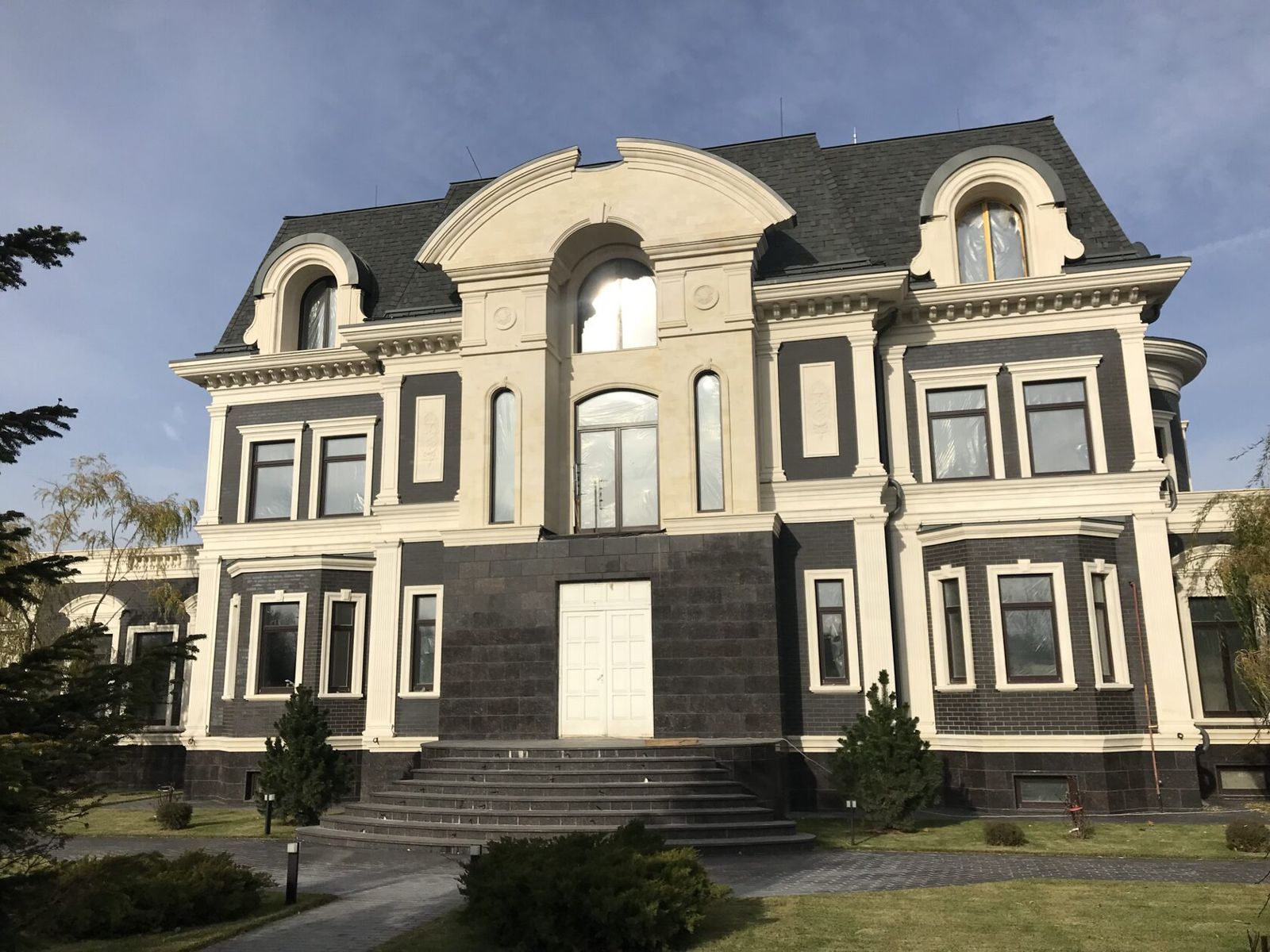
• Facades: strict graphite surfaces in contemporary architecture, often combined with light materials such as glass fibre reinforced concrete (GFRC), render and wood.
• Plinths: thanks to its density and dark colour, basalt does not show splashes and dirt.
• Entrances and steps, with a slip-resistant finish.
• Paving and landscaping: setts, slabs and kerbs for heavily loaded areas.
• Interiors: high-traffic floors and walls, washrooms in public buildings.
On south-facing facades dark stone heats up considerably. For a rainscreen facade this is not a problem, as the ventilated gap removes heat, but adhesive-fixed cladding requires movement joints and an adhesive with sufficient flexibility.
Basalt is often used as a contrasting material. A dark plinth under a light facade, graphite window surrounds and dark pylons at the entrance make the architecture stricter and more practical at the same time: dirt is less visible on dark stone. However, large continuous basalt surfaces look heavy, so they are usually broken up with joints, a combination of finishes or inserts of another material.
In landscaping basalt is chosen for areas that need maximum wear resistance: driveways, car parks and pedestrian areas at the entrances to public buildings. A rough finish keeps its slip resistance for years.
Installation
Basalt installation is similar to granite installation.
1. Ventilated rainscreen facade. Slabs, usually 20–30 mm thick or more (by calculation), are fixed to a metal substructure with clips or concealed anchors. Because of the high density, bracket spacing and profile sections are selected by calculation for dead weight and wind load.
2. Adhesive fixing for plinths and lower floors: tiles on frost-resistant natural stone adhesive, with full coverage, movement joints and mechanical safety fixings on large formats.
3. Massive elements (steps, parapets, kerbs) are set on mortar with anchors.
Only stainless fixings are used. Joints are filled with UV-resistant grouts or sealants; dark stone is well accentuated by a thin contrasting joint or, conversely, a matching grout.
TECHNOFORMA provides design, insulation and installation of ventilated rainscreen facade substructures with natural stone cladding. The cost is determined after a site inspection.
Comparison with Granite
Basalt and granite are both igneous rocks, but they formed differently, and this shows on the facade.
| Parameter | Basalt | Granite |
|---|---|---|
| Origin | extrusive rock, rapid cooling of lava | intrusive rock, slow crystallisation |
| Structure | fine-grained, uniform | coarse- and medium-grained, with visible grains |
| Colour | grey, graphite, almost black | grey, pink, red, black, beige |
| Density | generally higher | slightly lower |
| Quartz content | little or none | significant share |
| Polish | soft sheen | mirror shine |
| Colour choice | narrow | wide |
In terms of durability on a facade, both stones are among the best. Basalt is chosen for its uniform dark tone without visible grain, granite for its variety of colours and expressive pattern.
If the project allows both, the decision is usually made based on samples in the required finish and on the availability of enough volume from one batch: for a large facade it is important that all the stone is uniform in tone.
Examples from TECHNOFORMA Projects
Basalt is part of the TECHNOFORMA natural stone range. The company’s equipment processes both soft and hard rocks, so basalt slabs can be made to the layout of a facade or landscaping project. The stone is supplied from stock or to order; the company has established imports from India, Turkey, China and Iran.
The closest example in terms of properties among the company’s projects is the granite cladding of the Dinastia club house in Kislovodsk (700 m² of granite together with porcelain stoneware and GFRC; design and installation). All projects are in the TECHNOFORMA projects section. For interior tasks with stone, see the article “Onyx in interiors: backlighting and applications”.
FAQ
Is basalt suitable for facade tile cladding?
Yes. Basalt tiles are installed on adhesive for plinths and lower floors or on a rainscreen substructure for facades of any height.
How thick should basalt slabs be for a facade?
Usually 20–30 mm or more; the exact value is determined by calculation based on slab format, building height and wind load.
Which is stronger: basalt or granite?
Dense basalt is generally as strong as granite and slightly heavier. In practice both stones provide highly durable cladding.
Does dark basalt heat up in the sun?
Yes, noticeably more than light rocks. On a rainscreen facade the ventilated gap removes the heat; adhesive-fixed cladding needs movement joints and a flexible adhesive.
Is basalt slippery on steps?
Polished basalt is. For steps and paving a flamed or bush-hammered finish is used.