
Stone Imports: India, Turkey, China, Iran
Natural stone from India is above all granite and quartzitic sandstone in a wide range of colours, from black and green to warm yellow-brown. Together with Turkish marble and travertine, Chinese granite and Iranian onyx and travertine, it forms the core of the imported range for facades and interiors in Russia.
The main criterion when choosing imported stone is not the country but the specific quarry and batch: they determine colour, uniformity, porosity, strength and frost resistance. So the decision is made on samples and batch documents, and the project schedule is checked against whether the required item is in stock or has to be shipped to order.
TECHNOFORMA imports stone from India, Turkey, China and Iran, keeps stock from these countries in a warehouse in the Moscow region, and brings in items to order from other quarries. An overview of stones and applications is in the section Natural stone for facades and interiors.
Main source countries
Each of the four countries is known for its own stones. The summary below is industry guidance; the specific range in stock is confirmed for each project.
| Country | Known for | Typical use |
|---|---|---|
| India | Granites in a wide colour range, sandstones, slates, quartzites | Facades, plinths, paving, floors, stairs |
| Turkey | Marbles (including beige and white), travertines, limestones, onyx | Interiors, wall cladding, facades in mild climates or with protection |
| China | Granites in common grey, pink and black shades, basalts, large processing volumes | Facades, paving, kerbs, floors in public buildings |
| Iran | Travertines, onyx, marbles, limestones | Interiors, feature walls, travertine facades |
Besides imports, TECHNOFORMA has extensive experience with stones from Dagestan, which are in demand on projects in southern Russia. If the required stone is not available from these sources, it can be brought to order from quarries in other countries.
Quality
The quality of imported stone is determined by the quarry, the bed being worked and the care taken in processing at the factory. Stone sold under the same trade name can differ noticeably in colour and pattern from batch to batch. What is checked:
• Physical and mechanical properties: density, water absorption, compressive and flexural strength, frost resistance. Values depend on the quarry; they are taken from test reports for the specific batch, not from general reference books.
• Batch uniformity: colour, pattern, cavities, cracks, inclusions, glassy veins and rust spots from iron-bearing minerals.
• Geometry: tolerances on thickness, length and width, squareness of edges, flatness.
• Surface quality: uniformity of polishing, flaming, brushing; resin repairs and mesh on the back.
For a facade in the Russian climate, the key questions are frost resistance and water absorption: a soft marble or travertine that performs perfectly in southern Turkey will deteriorate in central Russia without protection and a proper construction. The stone is matched to the climate at the design stage.
Logistics
Stone from India, China, Turkey and Iran is shipped by sea in containers or by combined sea and land routes, with transhipment in ports. The main links in the chain:
1. selection of blocks or finished slabs at the factory, photo record of the batch;
2. cutting and processing to specification, if the stone is ordered cut to size;
3. packing: wooden crates or bundles of slabs on A-frames, spacers between polished faces;
4. sea freight to port, customs clearance;
5. delivery to the warehouse in Russia and on to the site.
Stone is heavy and fragile, so packing and the number of transhipments strongly affect cost and breakage. TECHNOFORMA has warehouses from Novorossiysk and Makhachkala to Novosibirsk and Yekaterinburg, and its production base and stone warehouses are in the Moscow region. This makes it possible to plan delivery according to the region of the project.
Lead times
The lead time for imported stone is made up of several stages, each depending on the specific order: availability of blocks of the required stone at the quarry, workload of the processing plant, volume and complexity of cutting, the transport route, customs and domestic delivery. There is no universal figure; it is given once the item and volume have been chosen.
How to shorten lead times in practice:
• at the design stage, check the selected items against warehouse stock: stock stone ships without waiting for sea freight;
• approve the layout and specification before ordering, so the volume does not have to be recalculated along the way;
• include an allowance for trimming and breakage in a single order: a top-up order from another batch takes longer and risks a colour mismatch;
• for large projects, split delivery into phases following the installation sequence.
Seasonality is also taken into account: quarries in some regions reduce extraction in the rainy season or in winter months, and in periods of high demand factories and container lines are more heavily loaded. The actual lead time for a specific item is fixed in the supply contract after the availability of blocks and the cutting schedule have been confirmed. For projects with a tight installation schedule, it makes sense to start purchasing stone in parallel with developing the working documentation, not after it is finished.
Warehouse in Russia
A warehouse in Russia serves three purposes: speed, the chance to see the stone in person and batch consistency. TECHNOFORMA keeps stone stock from all four import sources (India, Turkey, China, Iran) with a production base in the Moscow region. The stone is processed there too: the company's equipment handles both soft stones (sandstone, shell limestone, dolomite, limestone) and hard ones.
What this gives the client:
• selection from real slabs and samples rather than catalogue photos;
• cutting and edge and surface finishing to size for the project without another shipment abroad;
• layout, measurements by the company's own surveyors, 3D visualisation and installation in one workflow;
• supply to order from anywhere in the world if the required item is not in stock.
The range includes shell limestone, granite, basalt, dolomite, limestone, marble, onyx, sandstone and travertine.
Examples from TECHNOFORMA projects
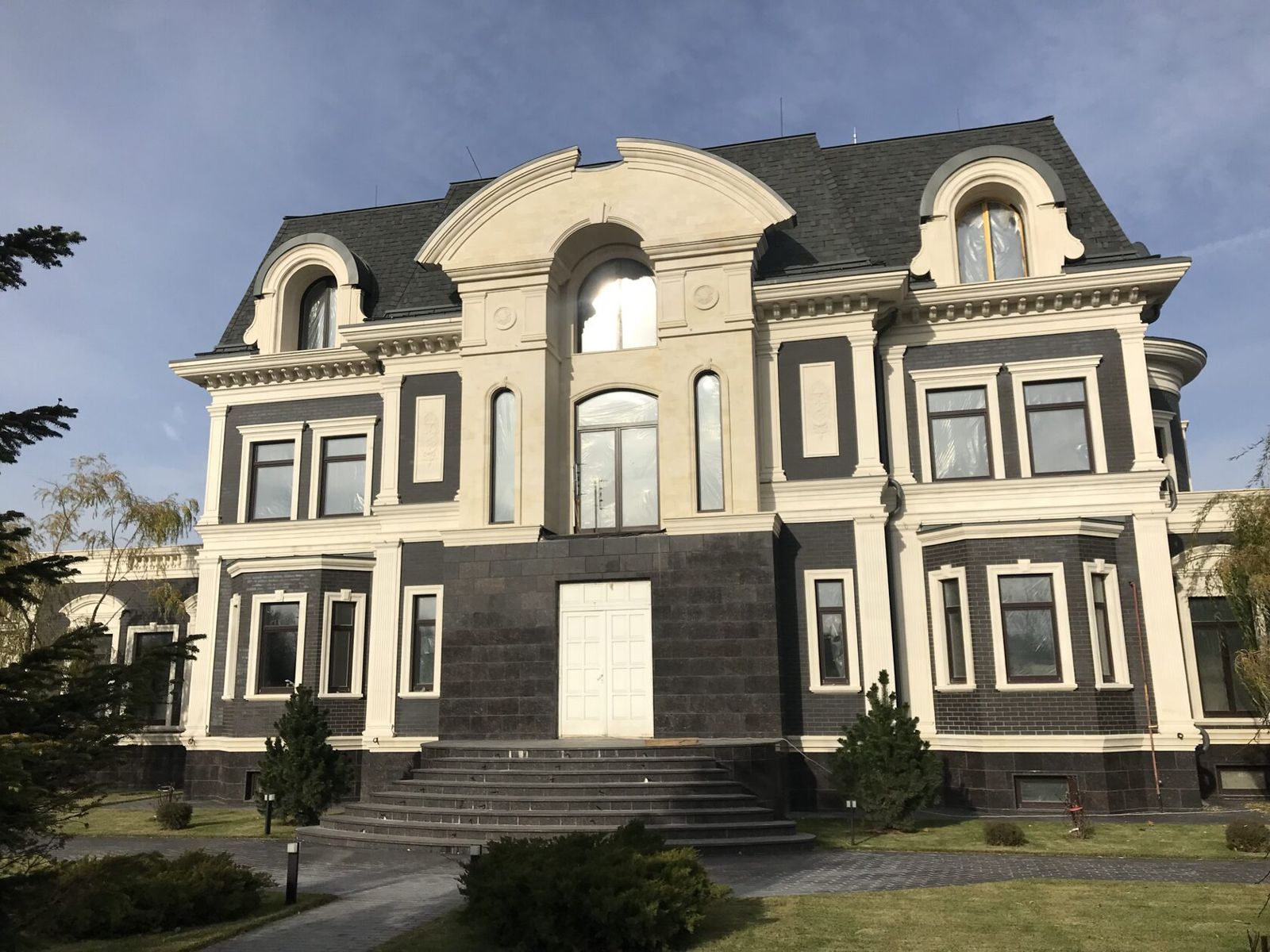
An example of a facade with natural stone is the Dinastiya club house in Kislovodsk: 9 storeys, 700 m² of granite combined with 6,000 m² of GFRC (glass fibre reinforced concrete) and 700 m² of porcelain stoneware, designed and installed by TECHNOFORMA in 2024–2025. The country of origin of the stone for this project is not stated on the website, so we do not name it.
More projects are in the TECHNOFORMA projects section. If you are choosing between stone and its substitutes, read Natural stone or porcelain stoneware on a facade.
FAQ
What is good about stone from Turkey?
Turkey is one of the largest sources of marble, travertine, limestone and onyx. These stones are valued for their warm shades and pattern; for facades in a cold climate they are chosen according to the frost resistance of the batch and protected with an impregnator.
Is stone from China lower in quality?
No, quality is determined by the quarry and processing, not the country. China supplies large volumes of granite and basalt; as with any import, the batch is checked against samples and test reports.
Which Indian natural stone is suitable for a facade?
Most often granites and dense sandstones and quartzites. Suitability of a specific item for the project's climate is confirmed by frost resistance and water absorption data for the batch.
Can you bring in stone that is not in stock?
Yes, TECHNOFORMA supplies stone to order from anywhere in the world. Lead times depend on the quarry, volume and route and are determined for each order.
Where can I see the stone in person?
At the warehouse in the Moscow region, which holds stone from India, Turkey, China and Iran. You can also request samples for your project.