
Natural Stone in Landscaping: Paths, Steps, Kerbs
Natural stone for landscaping includes setts, paving slabs, steps, kerbs, flagstone, boulders and crushed stone from natural rocks. It lasts for decades, does not fade, withstands loads and blends naturally into gardens, courtyards and public spaces.
The key selection criterion is the frost resistance and water absorption of the rock combined with a proper base: even the strongest granite will subside on a poorly prepared base, and porous stone will break down even on a good one.
The material is chosen by private homeowners, landscape architects and developers for landscaping projects. An overview of rocks is in the section Natural stone for facades and interiors.
Applications
Where natural stone is used in landscaping:
• Paths and pavements: sawn slabs, setts, flagstone, large stepping stones in lawns.
• Patios and terraces: seating areas, terraces, pool surrounds.
• Driveways and parking areas: setts and thick slabs of strong rocks.
• Steps and stairs: solid blocks or cladding treads and risers.
• Kerbs and edging: framing paths, lawns and flower beds.
• Retaining walls and terracing: dry-stone or mortared walls.
• Decorative features: rock gardens, dry stream beds, pond edging.
| Application | Suitable rocks |
|---|---|
| Driveways and parking areas | granite, basalt |
| Footpaths | granite, sandstone, dense dolomite, quartzite |
| Steps | granite, basalt, dense sandstone |
| Kerbs | granite, basalt |
| Retaining walls, decoration | sandstone, dolomite, limestone, granite rubble |
Stone Setts
Stone setts are rectangular or cubic units laid tightly together or with a narrow joint. They are the strongest and most durable surface for pedestrian areas and roadways.
Types of stone setts:
• Sawn: all faces flat, tight laying, comfortable to walk on.
• Sawn-split: sawn sides and a split top face; textured, non-slip, a classic look.
• Split: all faces split, the most historic look, uneven surface.
• Tumbled: with rounded edges, “antiqued”.
• Flamed: sawn with a rough top face.
Common sizes are 100×100×50 mm, 100×100×100 mm, 200×100×50–60 mm and others; thickness is chosen for the load. The main material is granite; basalt is also used, and less often sandstone and dense dolomite for pedestrian areas.
Setts are laid on a prepared base: excavation, geotextile, a compacted crushed-stone layer and a levelling layer of sand or dry mix. For trafficked areas the base is reinforced, in some cases with a concrete slab. Joints are filled with sand or special jointing compounds for setts. Falls and drainage are essential: water must not stand on the surface.
Unlike concrete pavers, stone setts do not wear down to grit or lose their colour: after decades they look the same or even better, acquiring a natural patina.
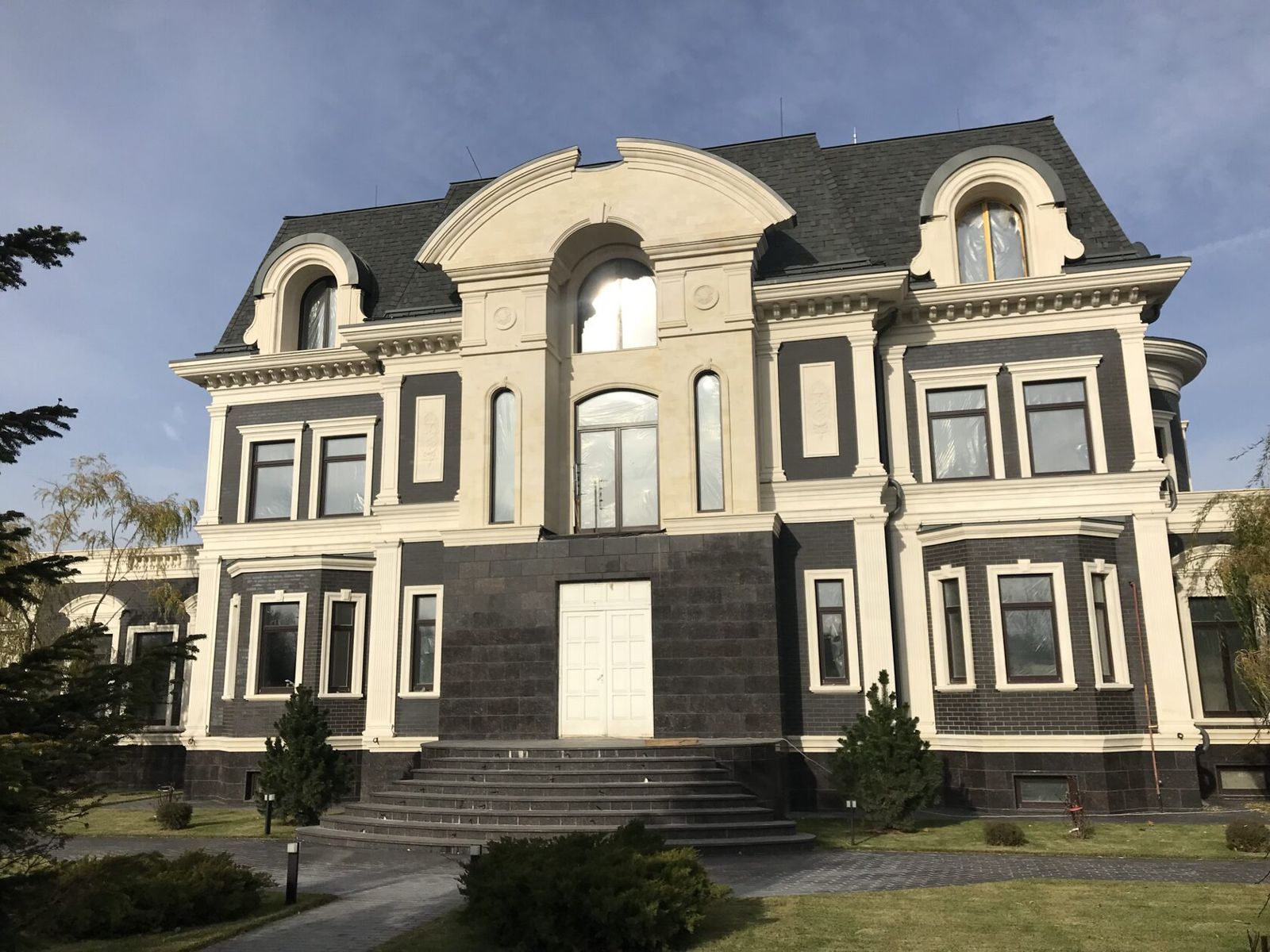
Steps
Stone steps are one of the most critical landscape elements: they are walked on every day, and in winter over snow and ice.
• Solid blocks: massive steps of solid stone, usually granite. They are laid on a prepared base and last almost forever.
• Cladding on a concrete base: treads 30–50 mm thick and risers 20–30 mm on a concrete flight.
• Flagstone and natural slabs: for garden paths with changes in level.
Requirements: a non-slip finish (flamed, bush-hammered, sandblasted or natural split), a 1–2% fall on the tread away from the building for drainage, and anti-slip grooves or inserts at the nosing. Step height and tread width should be comfortable to walk; outdoor stairs are usually made with a gentler pitch than indoor ones.
Clad steps need a reliable concrete base on a non-frost-susceptible bed, separated from the house structure by a movement joint. If the base settles or cracks, no stone will save the stairs. Tread nosings are chamfered or rounded: they chip less and are safer.
Kerbs
A kerb separates the path surface from the lawn or roadway, holds the edge of the paving and stops it spreading.
• Road kerb: tall, installed along a driveway, takes wheel impacts. Material: granite.
• Garden edging: low, for paths, lawns and flower beds. Granite, basalt, sandstone, dolomite.
• Radius kerb: for curved paths, made to a template.
A kerb is set on a concrete base and secured on the back with a concrete haunch. Natural stone is stronger than a concrete kerb, does not chip and needs no replacement for decades. The finish can be sawn, split or flamed, depending on the style of the landscaping.
The kerb is installed before the paving is laid: it serves as a guide and a restraint. The top of garden edging is usually set flush with the paving or a few centimetres higher, so that water does not run off the lawn onto the path and a lawnmower can pass along the edge unobstructed.
Frost Resistance
Frost resistance is the key characteristic of landscaping stone. A horizontal surface gets wet from rain and melting snow and then freezes; in central Russia there are dozens of such cycles per season. Water in the pores expands as it freezes and destroys weak stone.
| Rock | Typical frost resistance | For paving |
|---|---|---|
| Granite | high | suitable for any area |
| Basalt | high | suitable for any area |
| Quartz sandstone | medium–high | paths, patios |
| Dense dolomite | medium–high | pedestrian areas |
| Limestone | from low to medium | limited, in southern regions |
| Shell limestone | low | not recommended |
Values depend on the deposit; for a batch, refer to the test report.
Besides the rock itself, the frost resistance of the paving is affected by base drainage, falls for water run-off and avoiding salt de-icers. Sand or granite chippings are safer for treating stone paths in winter.
Examples from TECHNOFORMA Projects
TECHNOFORMA’s completed projects are primarily facades of residential complexes and public buildings, so the TECHNOFORMA projects section contains no examples of landscaping work. The company supplies natural stone for landscaping (granite, basalt, dolomite, sandstone, limestone) from its warehouse in the Moscow region or to order, and provides layout, 3D visualisation, measurements and installation.
Granite on a company project can be seen at the Dinastia club house in Kislovodsk (700 m² together with porcelain stoneware and glass fibre reinforced concrete (GFRC)). More on the most popular paving in the article “Natural stone setts”.
FAQ
Which stone is best for garden paths?
Granite, basalt, quartz sandstone or dense dolomite, with a rough finish and at least 30 mm thick for footpaths.
How thick should setts be for a driveway?
For cars, 60 mm or more; for footpaths, 30–50 mm is sufficient.
Can limestone be used for paths?
Only dense grades and mainly in southern regions; in central Russia granite or sandstone is more reliable.
Which finish should be chosen for outdoor steps?
A non-slip one: flamed, bush-hammered, sandblasted or natural split.
What should be spread on stone paths in winter?
Sand or granite chippings. Salt de-icers destroy the stone and the joints.