
Stone Finishes: Polishing, Honing, Bush-Hammering
Natural stone finishing means giving the surface of a slab the required texture after sawing: polishing, honing, flaming, bush-hammering, sandblasting, splitting and other methods. The finish determines not only the appearance (colour, shine, how vivid the pattern is) but also performance: slip resistance, resistance to soiling and how fast the stone ages outdoors.
The key criterion for choosing a finish is where the stone will work: a vertical wall or a horizontal surface, an interior or a facade, a high-traffic area or a decorative detail. The second criterion is the rock: not every finish can be achieved on every stone.
This article will help architects and designers preparing specifications, as well as clients choosing samples. An overview of rocks is in the section Natural stone for facades and interiors.
Polishing
Polishing is successive grinding of the surface with ever finer abrasives until a mirror shine is achieved. The final stage is done with polishing powders or pastes.
What polishing gives: it brings out the colour and pattern of the stone to the fullest, makes the surface smooth and dense and reduces dirt absorption. Polished granite looks darker and more contrasting than the same stone with a matt finish.
Limitations:
• slippery when wet, so polishing is not used on outdoor steps, landings or in wet areas;
• on soft rocks (marble, travertine, limestone, onyx) the polish scratches and wears, and outdoors it gradually disappears under acid rain;
• fingerprints, streaks and scratches are more visible on a polished surface.
Granite and quartz-bearing rocks retain their polish best. For them, polished slabs are a normal solution on vertical facade surfaces, portals and interiors. Soft rocks are polished mainly for interiors.
Honing
Honing is grinding to a smooth matt or semi-matt surface without a mirror shine. The process stops at a medium abrasive grit.
Honed stone looks calmer than polished stone: the colour is slightly lighter, the pattern softer and there is no glare. The surface remains smooth and pleasant to the touch.
• Pros: scratches and wear marks are less visible, lower slipperiness than polished stone, even ageing outdoors.
• Cons: it absorbs slightly more dirt than a polished surface, so impregnation is particularly advisable.
Honing is one of the most versatile finishes. It is used on marble, travertine and limestone facades (where a polish would dull anyway), on window sills, on interior floors and walls and on furniture elements. For outdoor horizontal surfaces honed stone may not be slip-resistant enough; more textured finishes are chosen there.
Flaming (Thermal Finish)
Flaming (thermal finishing) exposes the stone surface to a high-temperature gas jet. The sudden heating makes the top layer of grains expand unevenly and spall off, creating a rough surface with fine relief.
Features:
• used mainly on granite and other quartz-bearing rocks; carbonate stones (marble, limestone) are not suitable for this finish;
• the stone becomes lighter and the pattern more muted;
• the surface is non-slip even when wet;
• the treatment affects a few millimetres, so slabs for flaming are taken with extra thickness, usually 20 mm and above;
• the roughness hides dirt and signs of use.
Flamed granite is the standard for outdoor steps, landings, paving, plinths and ramps. It is often combined with polished stone of the same grade: for example, a polished portal wall and flamed steps at the entrance.
After flaming, the surface is sometimes additionally brushed to remove sharp edges and make the texture softer to the touch. This option is convenient for areas where people walk barefoot, such as around swimming pools.
Bush-Hammering
Bush-hammering is the treatment of a stone surface with an impact tool that has pyramid-shaped teeth (a bush hammer). The blows leave an even dotted texture on the surface. It used to be done by hand; today it is done by machine or with pneumatic tools.
The texture can be coarse or fine depending on the spacing of the teeth. After treatment the stone becomes lighter and matt, with a soft play of light on the relief.
• suitable for hard rocks (granite, basalt) as well as dense carbonate rocks (dolomite, limestone, travertine);
• provides good slip resistance;
• looks hand-crafted, so it is popular in classical and historic architecture;
• like flaming, bush-hammering requires sufficient slab thickness.
Bush-hammered stone is used on steps, plinths, paving and parapets, and also decoratively, for example as a contrasting border around a polished field.
Choosing a Finish for the Facade
The choice of finish for a facade can be summarised in a table.
| Finish | Vertical facade | Plinth | Steps and landings | Interior |
|---|---|---|---|---|
| Polished | yes, for granite and basalt | acceptable, but dirt shows | no | yes |
| Honed | yes, for all rocks | yes | limited | yes |
| Flamed | yes, for granite | yes | yes | rarely |
| Bush-hammered | yes | yes | yes | decorative |
| Split (rock-faced) | as an accent | yes | no | decorative |
| Sandblasted | yes | yes | limited | yes |
In addition to these, sandblasting (even fine roughness), antiqued/brushed finishes (an aged surface made with wire brushes), rock-faced split finishes and tumbling (rounded tile edges) are used. Several finishes in one project are a good way to emphasise the architecture: smooth wall surfaces, a textured plinth, rough steps.
Tip: view samples in exactly the finish that will be used on site, and in daylight: the finish changes the tone of the same stone more noticeably than a catalogue suggests.
Examples from TECHNOFORMA Projects
TECHNOFORMA’s production base in the Moscow region is equipped to process both soft rocks (sandstone, shell limestone, dolomite, limestone) and hard ones. The stone can therefore be prepared for the specific layout and finish of a project.
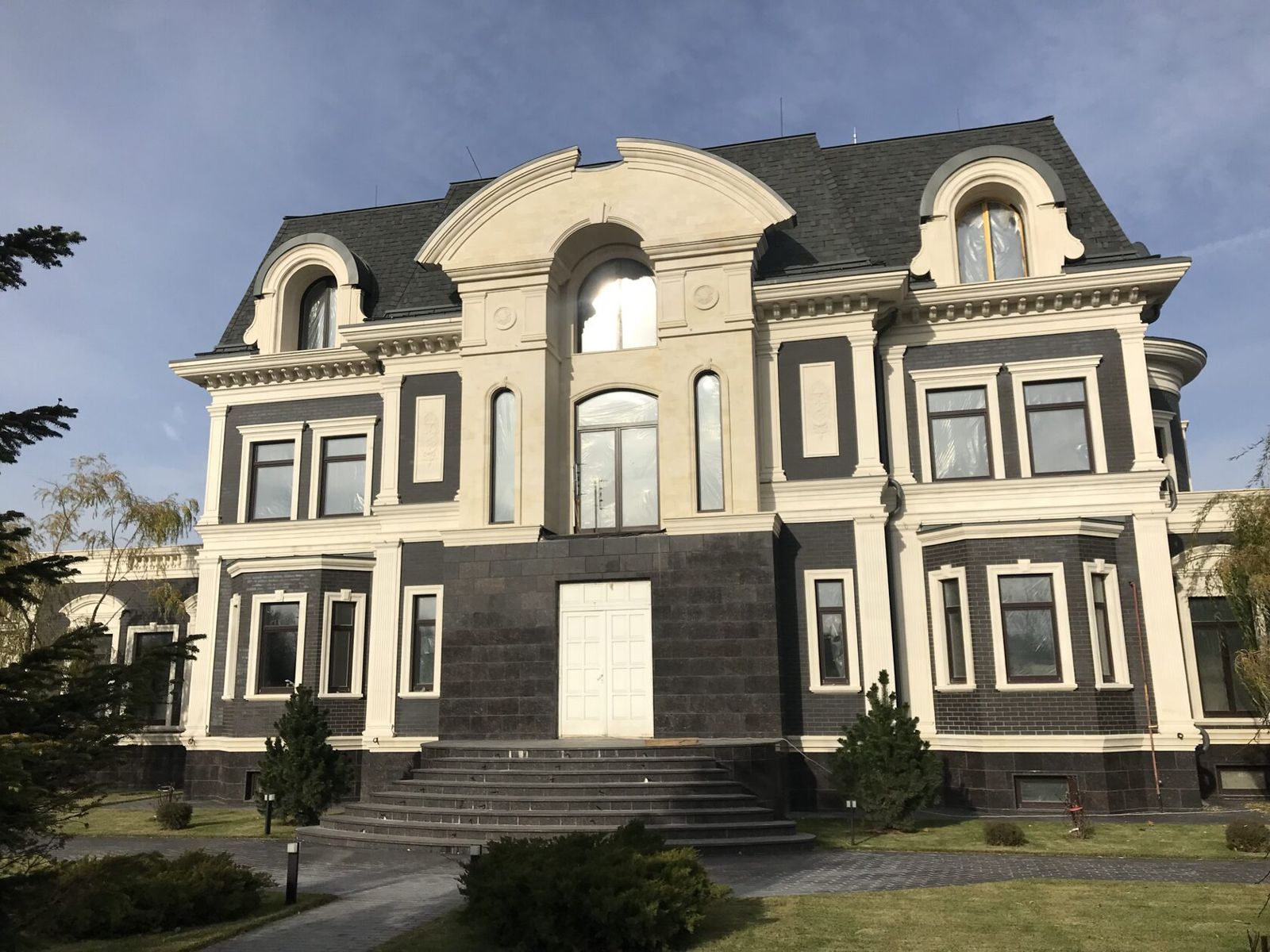
At the Dinastia club house in Kislovodsk, natural granite (700 m²) works together with porcelain stoneware and glass fibre reinforced concrete (GFRC); design and installation were carried out by the company. Other projects are in the TECHNOFORMA projects section. Slab thickness is directly linked to the finish; see the article “Thickness of stone cladding slabs”.
FAQ
What types of stone finishes are there?
The main ones are polished, honed, flamed (thermal), bush-hammered, sandblasted, brushed (antiqued), split rock-faced, tumbled and sawn.
Which finish should be chosen for outdoor steps?
A non-slip one: flamed, bush-hammered or sandblasted. Polished stone is not used on outdoor horizontal surfaces.
Can marble be flamed?
No, flaming suits granite and other quartz-bearing rocks. For marble, honing, bush-hammering, sandblasting or brushing are used.
Why does polished marble dull on a facade?
Calcite slowly dissolves in acid rain. That is why marble facades more often use a honed or matt finish.
Does the finish change the colour of the stone?
Yes. Polishing makes stone darker and more contrasting; rough finishes make it lighter with a softer pattern.