
Comparing Facade Stone Types: A Table of Properties
There is no universally best stone for a facade: the choice depends on the building zone, climate and budget. For plinths, steps and regions with frequent freeze-thaw cycles, granite and basalt are the most reliable. For walls in a temperate climate, dense dolomites, limestones, sandstones and travertine work well. Marble suits details and lower floors, shell limestone (coquina) suits sheltered areas and dry climates, and onyx is for interiors only.
The main criterion is not the name of the stone but the properties of the specific batch: water absorption, frost resistance and strength from the test report.
This table is useful for architects at the concept stage, developers choosing finishes and private clients comparing cladding options. Each stone is covered in detail in the Natural stone for facades and interiors section.
Comparison Criteria
Natural stone for facades is best compared on several parameters.
• Water absorption is the key outdoor indicator. The less water a stone absorbs, the less it suffers from frost, soiling and efflorescence.
• Frost resistance is the number of freeze-thaw cycles without loss of strength. Requirements for plinths and horizontal surfaces are higher than for walls.
• Strength in compression and bending determines the permissible slab thickness, format size and fixing method.
• Density determines the weight of the cladding and the load on the substructure and wall.
• Acid resistance matters in cities: carbonate stones (marble, limestone, travertine, dolomite) gradually lose their polish, while silicate stones (granite, basalt, quartz sandstone) do not.
• Workability: soft stones are easy to cut and profile; hard stones need diamond tools but last longer.
• Appearance and batch consistency: colour, pattern, and the ability to obtain the required volume in one tone.
All numerical values depend on the quarry. For a design, values are taken from the product data sheet or test report, not from averaged reference data.
A separate question is natural versus artificial stone. Cement-based artificial stone is lighter and cheaper, but its durability depends on the mix, and its colour is often set by pigment in the surface layer. Natural stone is more expensive and heavier, but its properties are confirmed by test reports and its appearance changes slowly. For multi-storey facades with complex decoration there is a third option: GFRC with a stone texture. It does not replace genuine natural texture, but it allows lightweight cornices and columns.
Comparison Table
Below is a summary table of the stones used for facade cladding. Values are indicative and refer to typical dense cladding grades.
| Stone | Density, kg/m³ | Water absorption | Frost resistance | Acid resistance | Workability | Best use |
|---|---|---|---|---|---|---|
| Granite | 2600–2800 | very low | high | high | difficult | plinth, steps, whole facade |
| Basalt | 2700–3100 | very low | high | high | difficult | plinth, paving, dark facades |
| Marble | 2600–2800 | low | medium to high | low | medium | portals, columns, interiors |
| Travertine | 2300–2600 | low to medium | medium | low | easy | walls, rainscreen facades |
| Dolomite | 2300–2800 | low to medium | medium to high | medium | easy | walls, plinth, paving |
| Limestone | 1800–2600 | low to high | low to medium | low | easy | walls, decoration |
| Sandstone | 2000–2700 | low to medium | medium to high | high for quartz types | medium | walls, plinth, landscaping |
| Shell limestone (coquina) | 900–2200 | high | low to medium | low | very easy | walls in dry climates, interiors |
| Onyx | 2600–2800 | low | not for outdoor use | low | difficult due to brittleness | interiors only |
The table shows the overall picture. The spread within one stone type can be greater than between types: a dense limestone can be more reliable than a loose sandstone. That is why the final choice is made from the batch documents.
Guide values for water absorption and strength of typical cladding grades (they depend on the quarry; exact values are in the batch test report):
| Stone | Water absorption by weight, guide | Compressive strength, MPa, guide | Typical slab thickness in a rainscreen facade |
|---|---|---|---|
| Granite, basalt | up to 0.5% | 100–250 | 20–30 mm |
| Marble | up to 0.5% | 50–150 | 30 mm or more |
| Travertine, dense limestone, dolomite | 1–5% | 30–100 | 30–40 mm |
| Sandstone | 1–8% | 30–150 | 30–40 mm |
| Shell limestone | 10% or more | 1–15 | masonry or thick slabs, not thin rainscreen cladding |
Climate
Climate determines how strict the requirements for stone must be.
• Central and northern Russia. Many freeze-thaw cycles, wet snow, de-icing salts. Granite or basalt for plinths and horizontal surfaces; dense stones with low water absorption and proven frost resistance for walls. Porous stones only with water-repellent treatment and on a rainscreen system.
• Southern Russia and the Caucasus. Less frost, more sun and day-night temperature swings. Limestones, dolomites, sandstones and travertine work well here; shell limestone is traditionally used for walls. For dark stones on sunny facades, heating is taken into account.
• Coastal areas. Sea salt destroys porous stone and leaves efflorescence. Dense stones and regular washing are preferable.
• Cities with polluted air. Carbonate stones lose their polish, so matt finishes or silicate stones are chosen.
Regardless of climate, construction details strongly affect durability: sills, the perimeter apron, damp-proof courses and the ventilated cavity often matter more than the difference between two similar stones.
For stone laid in mortar, porous stones need a damp-proof course at the plinth and a compatible mortar: an overly strong and dense cement mortar forces moisture and salts to leave through the stone rather than through the joints.
Budget
The budget for a stone facade is made up of more than the price of the stone itself. It includes:
• the cost of the stone, which depends on the type, quarry, colour, format and thickness;
• processing: cutting to the layout, surface finishing, kerfs, chamfers;
• substructure and fixings: heavy stone requires a stronger substructure;
• installation and logistics.
General patterns: hard stones (granite, basalt) cost more to process; soft stones are cheaper to process but may need a greater thickness. Imported stone in rare colours costs more than local stones. Large formats cost more to process and install than standard tiles.
A sensible way to manage the budget is to combine materials: granite or basalt on the plinth and at the entrance, and more affordable stone or stone-look GFRC on the main planes. At TECHNOFORMA the cost of construction and installation work is determined after a site inspection, and the estimate is based on the design or photos of the facade.
Recommendations
Short recommendations for choosing facade stone:
1. For plinths, steps and landings: granite, basalt or the densest dolomites and quartz sandstones with a textured finish.
2. For the walls of a private house in central Russia: dense dolomite, sandstone, travertine; granite if the maximum durability margin is needed.
3. For a multi-storey building: a ventilated rainscreen facade with engineered fixings; stone is chosen by flexural strength and weight.
4. For prestigious portals and columns: marble or granite; marble with the loss of polish outdoors in mind.
5. For southern regions and warm tones: limestone, dolomite, shell limestone, always with water-repellent treatment.
6. For complex sculptural forms (cornices, capitals, large details), consider GFRC: it reproduces the look of stone but is lighter and allows any shape.
7. Before ordering: test reports, samples from the current batch and a layout.
Typical mistakes when choosing stone:
• choosing from a photo or showroom sample, without test reports or a sample from the supplied batch;
• a polished surface on steps and landings, which is slippery in winter and rain;
• porous stone on the plinth without water-repellent treatment and protection from de-icing salts;
• ordering without a margin for tone matching and breakage during processing;
• thin slabs of soft stone on a rainscreen system without a flexural calculation;
• mixing batches of different tone on one plane.
When natural stone is not the best choice: when the load-bearing capacity of the walls is limited and they cannot be strengthened, for large complex sculptural forms at height, and under tight deadlines when the required volume in one tone cannot be sourced from stock. Stone masonry (rubble, flagstone, sawn tiles) is chosen for low-rise buildings and plinths; for multi-storey buildings, slabs on a substructure as rainscreen cladding.
Examples from TECHNOFORMA Projects
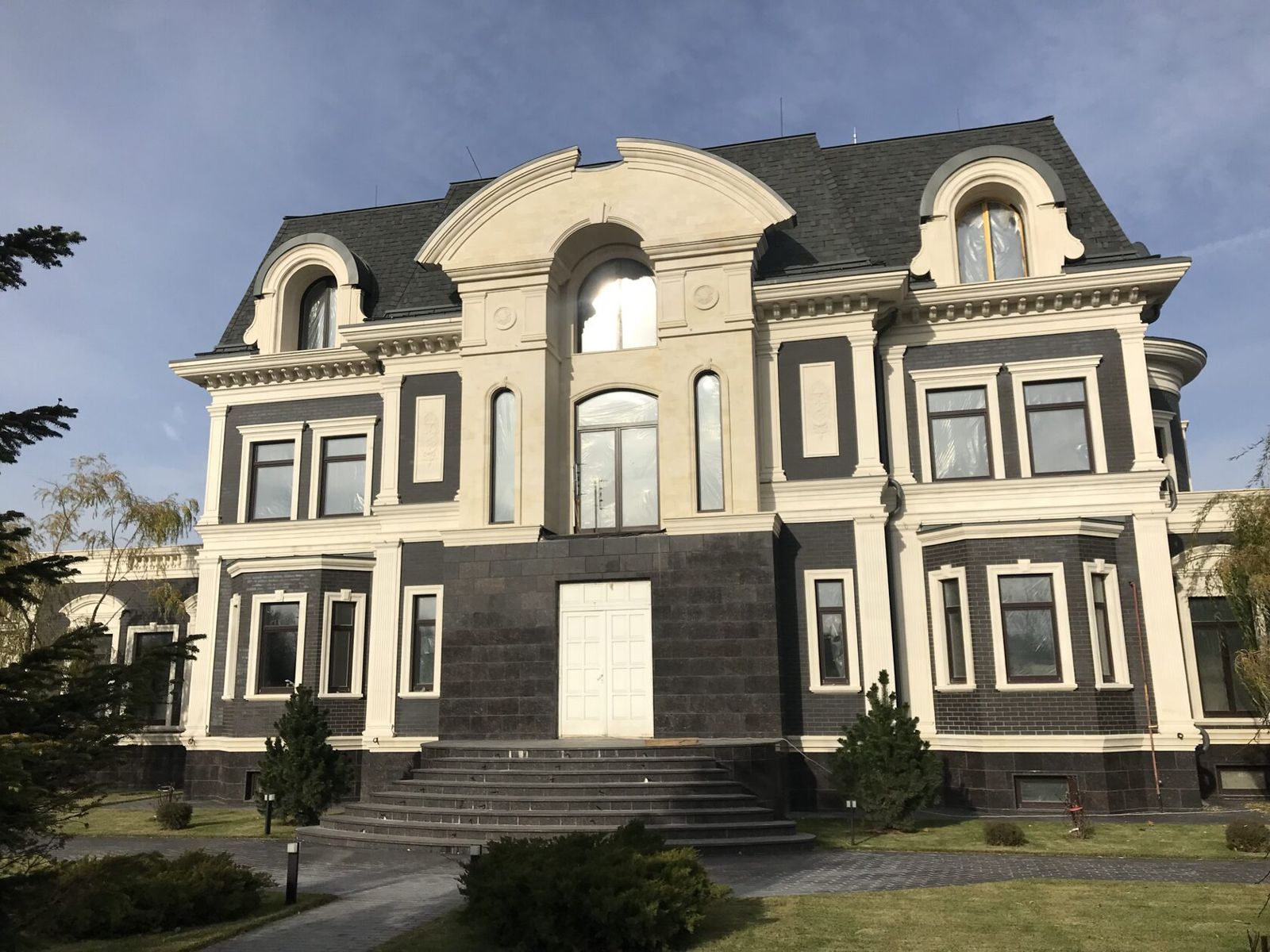
At the Dinastiya club house in Kislovodsk, TECHNOFORMA combined materials: 700 m² of granite, 700 m² of porcelain stoneware and 6,000 m² of GFRC, with design and installation by the company. At the Dominanta residential complex in Makhachkala, the facade is made of GFRC (14,000 m²) and porcelain stoneware (13,000 m²). Such combinations are a practical answer to balancing durability, appearance and budget.
Other work is in the TECHNOFORMA projects section. For how surface finish changes the look and behaviour of stone, see Stone finishes: polished, honed, bush-hammered.
FAQ
Which stone is best for the facade of a private house?
Granite or basalt for the plinth; dense dolomite, sandstone or travertine for the walls. The final choice depends on climate, finish and the properties of the batch.
Which natural stone is the most durable outdoors?
Granite and basalt: they have very low water absorption and high frost and acid resistance.
Can marble and travertine be used on a facade?
Yes, on a rainscreen system, bearing in mind that the polished surface of carbonate stones dulls over time outdoors.
What matters more when choosing stone: the type or the properties?
The properties of the specific batch: water absorption, frost resistance and strength from the test report. The spread within one stone type can be large.
How can I save money on a stone facade?
Combine materials: durable stone on the plinth and at the entrance, and more affordable materials or GFRC on the main planes.
Which is better for a facade: natural or artificial stone?
Natural stone is more expensive and heavier, but its properties are confirmed by test reports and it keeps its appearance for a long time. Artificial stone is lighter and cheaper, but its durability depends on the mix. For complex decoration on multi-storey buildings, stone-textured GFRC is often chosen.