
Artificial Stone for Facades: Types and Differences from Natural Stone
Artificial stone for facades covers cladding products that imitate natural stone but are made industrially: from concrete with pigments and aggregates, gypsum, polymer binders, GFRC (glass fibre reinforced concrete), as well as sintered materials such as clinker and porcelain stoneware. They reproduce the texture of dolomite, slate, sandstone, rubble and split-face stone at a lower weight and price than natural stone.
The main criterion for a facade is not the catalogue look but frost resistance, water absorption and the fixing method. Gypsum stone, good for interiors, breaks down outdoors; concrete stone suits exterior cladding if its frost resistance is confirmed; GFRC makes it possible to produce large and three-dimensional elements on a rainscreen system.
The material is chosen by private homeowners for cladding facades and foundations, and by developers who need the look of stone over a large area with limited weight. A general overview of natural stones is in the section Natural stone for facades and interiors.
Types of artificial stone
Artificial stone for exterior cladding comes in several technologies. They look similar but behave differently outdoors.
• Concrete (cement-sand) stone. The most common manufactured cladding stone for house facades: tiles usually 15–40 mm thick with a dolomite, slate, brick or rubble texture. Dolomite-look ranges from various manufacturers are sold in modules of a set length and in colours such as chocolate brown or dark grey. They are bonded to the wall or plinth with adhesive and are also suitable for foundation cladding if their frost resistance is adequate.
• Gypsum stone. Light, cheap, reproduces texture accurately, but absorbs moisture. Intended for interiors; not used on facades without protection.
• Polymer and polymer concrete panels. Lightweight sheets or panels of resin with stone particles; installed on battens, quickly, but the texture is less natural.
• Agglomerates and engineered quartz. Stone particles in a polymer binder, mostly for interiors and worktops; on facades they are limited by the UV resistance of the binder.
• Stone-look clinker and porcelain stoneware. Sintered materials with very low water absorption; clinker tiles for plinths and walls, porcelain stoneware for ventilated facades.
• GFRC. Thin-walled products made of a cement matrix reinforced with glass fibre; they reproduce the texture and colour of stone and make it possible to produce cornices, columns, window surrounds and large panels for a rainscreen facade.
Gypsum and concrete
Gypsum and concrete are the two bases for most decorative stone used in private construction. The difference is fundamental.
| Parameter | Gypsum stone | Concrete stone |
|---|---|---|
| Where used | Interiors: walls, reveals, fireplaces (within permitted temperatures) | Facades, plinths, foundations, fences, interiors |
| Behaviour with water | Absorbs moisture, softens, needs impregnation even indoors | Lower water absorption, durability depends on the mix |
| Frost resistance | Not designed for freeze cycles | Confirmed by the manufacturer for a specific range |
| Weight | Light | Heavier, needs exterior-grade adhesive |
| Edge strength | Brittle, chips easily | Stronger, but may crumble if poor quality |
Conclusion: for facades and plinths, concrete stone with documented frost resistance and water absorption is suitable; gypsum only indoors. Rely on the product certificate, not on the words “for facades” on the packaging.
Quality
The quality of artificial stone depends on the mix design, the moulding technology and production control. What to check before buying:
• Frost resistance and water absorption from documents for the specific range. Requirements for plinths and foundations are higher than for walls: they get splashes, snow and de-icing salts.
• Colouring. It is better when pigment is mixed through the body rather than only applied on top: a chip will not reveal a grey base.
• Batch uniformity: shade, dimensions, thickness. For one facade, buy stone from a single batch with an allowance.
• Back face: should be rough for adhesive bond, without an oily film from the moulds.
• Geometry and edges: no cracks, voids or crumbling edges.
• Installation system. Exterior adhesive, grout, water repellent, preferably from the system recommended by the manufacturer.
For GFRC, quality also depends on the content and distribution of glass fibre and on the curing technology; these parameters are recorded in the manufacturer's product certificate.
Comparison
Comparison of artificial and natural stone on a facade:
| Parameter | Natural stone | Artificial (concrete, GFRC) |
|---|---|---|
| Appearance | Unique pattern, depth of colour | Repeating texture, consistent batch colour |
| Weight | Higher: slabs 20–40 mm | Lower, especially thin-walled GFRC |
| Freedom of form | Limited by sawing and milling | Any shape from a model: cornices, columns, relief |
| Durability | Dense stones: centuries | Depends on mix design and production quality |
| Repair | Grinding, polishing | Repair compounds, element replacement |
| Cost | Higher on average | Lower, especially for three-dimensional ornament |
Natural stone wins where the material is seen up close and uniqueness matters. Artificial stone wins where large quantities of identical elements, complex shapes or weight limits are needed.
How to choose
How to choose artificial stone for a facade:
1. Define the area: wall, plinth, foundation, decorative elements. The plinth has the strictest frost resistance requirements.
2. Check the substrate: load-bearing capacity of the wall, presence of insulation. Adhered stone over insulation is installed only as part of a certified system.
3. Choose the fixing method: adhesive on the wall or a rainscreen substructure. For multi-storey buildings and large elements, only the rainscreen option.
4. Request documents: product certificate, frost resistance and water absorption test reports.
5. Look at samples in daylight and compare them with the other facade materials: windows, roof, render.
6. Allow extra for trimming and breakage from the same batch.
Examples from TECHNOFORMA projects
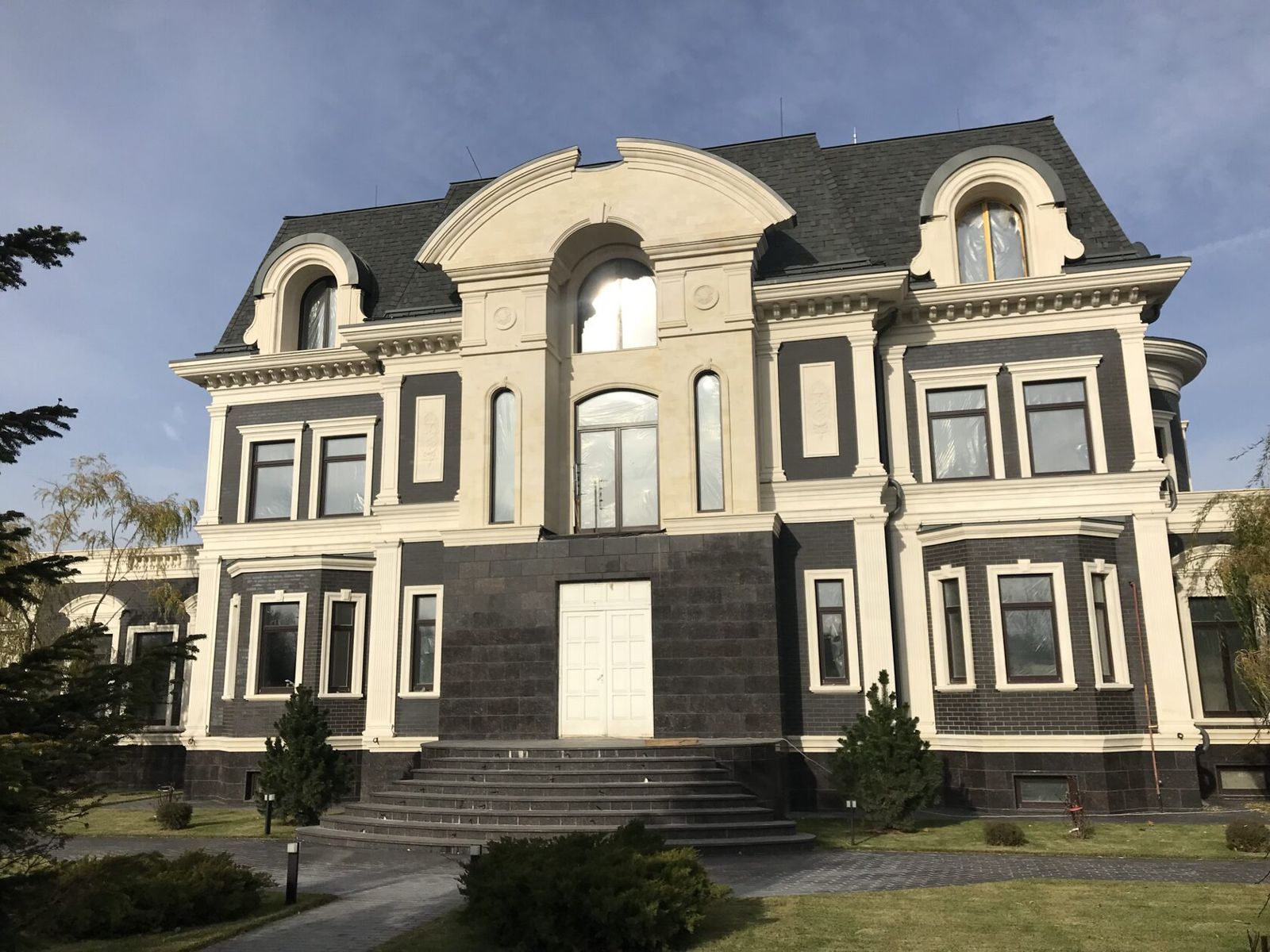
TECHNOFORMA manufactures GFRC, one of the options for artificial facade stone, and also supplies natural stone, so its projects often combine both materials. The Dinastiya club house in Kislovodsk has 6,000 m² of GFRC alongside 700 m² of natural granite and 700 m² of porcelain stoneware. A large-scale example of a GFRC facade is the Dubai Houses residential complex in Grozny: 30 buildings, 70,000 m² of GFRC, design and installation.
Other projects are in the TECHNOFORMA projects section. On preparing for natural stone cladding, read Stone layout: pattern matching and slab marking.
FAQ
What is decorative facade stone?
It is a general term for cladding products with a stone texture: natural slabs or artificial materials such as concrete stone, clinker, porcelain stoneware and GFRC. Only frost-resistant, low-absorption options are used on facades.
Can gypsum decorative stone be used on a facade?
No. Gypsum stone absorbs moisture and is not designed for freeze cycles; it is intended for interiors. A facade needs concrete stone, clinker, GFRC or natural stone.
Is artificial stone suitable for cladding a foundation?
Concrete stone with confirmed frost resistance is suitable, laid with exterior adhesive on a waterproofed substrate. The plinth is the area most exposed to moisture, so material requirements there are higher.
Which is better for a decorative facade, natural or artificial stone?
Natural stone for an inimitable texture and maximum durability. Artificial stone, including GFRC, for complex shapes, large volumes and limited weight. They are often combined.
Does artificial stone need impregnation?
Concrete stone on a facade is usually treated with a water repellent after installation and grouting; this reduces water absorption, soiling and the risk of efflorescence.