
What Determines the Price of Natural Stone
The price of natural stone is not a single figure per square metre of slab but the sum of several components: the cost of the stone at the quarry, sawing and processing, thickness, waste from cutting and pattern matching, delivery, substructure and installation. So the same granite costs differently on a warehouse price list and on a finished facade, and two stones with a similar slab price can produce very different final estimates.
The key principle of comparison is to calculate the cost per finished square metre of cladding on a specific project, not the price of the material. It is affected by slab format, facade complexity, building height, region and schedule.
The article will be useful to developers, estimators, architects and private homeowners planning a cladding budget. TECHNOFORMA determines the specific cost of works after a site inspection; the article contains no ready-made prices. An overview of stones is in the section Natural stone for facades and interiors.
Stone type and origin
The first factor that determines the price is the stone type and the specific quarry.
• Availability. Common grey and pink granites are quarried in huge volumes and cost noticeably less than rare colours: blue, green, deep black without inclusions.
• Decorative value. White marbles with a clean background, onyx and marbles with a striking pattern are valued higher because of rarity and high extraction waste.
• Yield from the block. Fractured quarries give fewer good slabs, so the cost of usable stone rises.
• Grade and selection. Within one stone there are grades: those without spots and inclusions and with a uniform tone are more expensive.
• Country and route. India, Turkey, China and Iran differ in the cost of extraction, processing and delivery route.
TECHNOFORMA works with stone from India, Turkey, China and Iran from its own warehouse, supplies items to order from anywhere in the world and has extensive experience with stones from Dagestan. The choice between a stock item and one ordered in affects both price and lead time.
Thickness and finish
Thickness determines the amount of stone per square metre and its resistance to loads. Interior walls use slabs of about 10–20 mm, floors and rainscreen facades more often 20–40 mm, steps 30 mm or more. A thicker slab means a higher material price, more weight, higher substructure requirements and more labour-intensive installation.
Surface and edge finishing is the second cost item:
| Finish | Look | Effect on cost |
|---|---|---|
| Sawn | Flat and rough after sawing | Base |
| Honed | Smooth matt | Higher than sawn |
| Polished | Mirror gloss, brings out the pattern | Higher than honed |
| Flamed | Rough, anti-slip (for granite) | Additional operation |
| Bush-hammered, brushed | Textured, aged | Additional operation |
| Edge profiling, kerf milling | Chamfers, rounded edges, kerfs for clips | Depends on edge length and complexity |
Non-standard elements such as balusters, cornices, columns and carving are priced separately and often cost an order of magnitude more per unit area than flat cladding. In such cases they are compared with a GFRC (glass fibre reinforced concrete) option.
Waste
Waste is the part of the stone that is paid for but does not end up on the wall. Its sources:
• Slab cutting. Slabs have uneven edges and a limited size; design-format pieces are cut from them, and offcuts go to small elements or waste.
• Pattern matching. For book-matched marble and onyx, part of the slab is cut not in the most economical way but in the most beautiful one.
• Rejection. Cracks, cavities and stains are cut out.
• Cuts on site. At openings, corners and junctions.
• Breakage in transport and installation.
• Reserve. Spare stone from the same batch for replacements is a mandatory part of the order.
The share of waste depends on the stone, format and complexity of the facade. It is reduced by a layout based on real slabs, choosing a slab format that suits the slab size, and surveying before cutting. That is why layout and 3D visualisation pay off first and foremost on expensive stones.
Waste also matters when comparing supplier quotes. One quote may be based on the net facade area, another may include cutting, trimming and reserve. The first looks cheaper but leads to a top-up order on site, and a top-up from another batch risks a tone mismatch. So the correct comparison is between estimates calculated on the same layout, with the same reserve and the same assumptions about edge finishing.
Logistics
Stone is heavy and fragile, so logistics is a significant part of the price, especially for imported items. It includes:
• sea or multimodal freight from the country of origin;
• customs clearance;
• packing: crates, slab racks, spacers;
• delivery from the warehouse to the site, unloading with a crane truck;
• storage on site until installation.
A warehouse in Russia removes the wait for sea freight from the schedule: items in stock ship immediately. TECHNOFORMA has warehouses from Novorossiysk and Makhachkala to Novosibirsk and Yekaterinburg, and its production base and stone warehouses are in the Moscow region. The closer the warehouse is to the site and the fewer transhipments, the lower the transport component and the risk of breakage.
Installation
On a facade the cost of installation is as significant as the cost of the stone. It is determined by:
1. Fixing method. A ventilated rainscreen system with substructure, insulation and clips, or adhesive fixing to the substrate (for plinths and low-rise buildings).
2. Substructure. For stone it is heavier than for porcelain stoneware because of the weight, with more closely spaced anchors.
3. Height and access. Scaffolding, cradles, lifts, rigging for heavy slabs.
4. Facade complexity. The number of corners, reveals, bay windows and curved sections.
5. Slab format. Large slabs mean fewer joints but heavier installation.
6. Season. Winter installation requires additional measures.
TECHNOFORMA carries out design, insulation, installation of ventilated rainscreen substructures and natural stone cladding with its own installation teams of more than 100 specialists. The cost of works is determined after a site inspection.
Examples from TECHNOFORMA projects
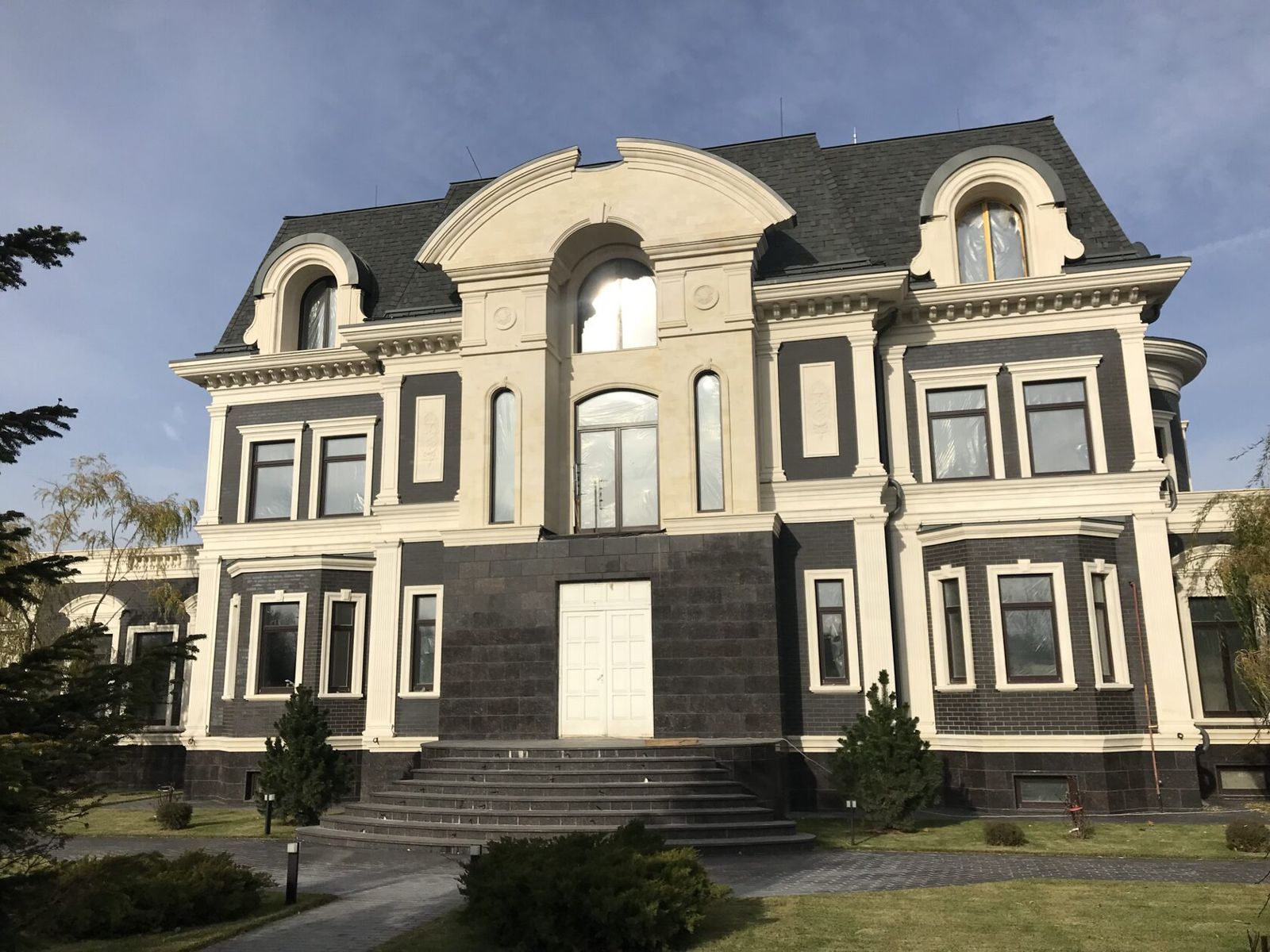
An example of a facade combining natural stone with other materials is the Dinastiya club house in Kislovodsk: 700 m² of granite, with the main area in 6,000 m² of GFRC and 700 m² of porcelain stoneware. This combination is a typical way of managing the budget: stone where it is seen up close, lighter materials on the rest of the area. The company does not publish the project cost.
Other projects are in the TECHNOFORMA projects section. The purchasing process from sample to delivery is described in How to order stone for a project: from sample to delivery.
FAQ
Why do natural stone prices vary so much?
Because of the rarity of the stone, grade, yield from the block, thickness, finish and logistics. Common granite and rare onyx can differ in price several times over.
Which costs more, the material or the installation?
It depends on the stone and the project. On a rainscreen facade the substructure and installation make up a significant part of the estimate, so the cost per finished square metre is compared.
How can the cost of stone cladding be reduced?
Choose a stock item, match the slab format to the slab size, prepare a layout before cutting, and combine stone with porcelain stoneware or GFRC.
Can I find out the price of a stone facade in advance?
An estimate is possible from the design and specification. TECHNOFORMA determines the exact cost of works after a site inspection.
How much extra stone should be ordered?
The reserve depends on the complexity of the facade and the stone; it is determined from the layout. It should be ordered from the same batch so that replacements match in colour.