
Natural Stone for Facades: Which Types Are Suitable
Natural stone for facades means slabs and architectural elements made of rock that can withstand outdoor conditions: temperature swings, freeze-thaw cycles, precipitation, UV and pollution. Not every stone type, and not every quarry of the same stone, is suitable for cladding, so the choice is not "granite" or "limestone" in general but a specific stone with confirmed properties.
The main selection criterion is the combination of frost resistance, water absorption and strength with the architectural brief and the climate. Hard stones (granite, basalt) are for plinths, steps and high loads; soft stones (limestone, sandstone, shell limestone, travertine) are for expressive wall surfaces and carved ornament in a suitable climate and with protection.
This article is for architects, developers and private homeowners. For an overview, see Natural stone for facades and interiors.
Requirements for facade stone
Cladding stone for exterior use is assessed on several properties. Their values depend on the quarry and even on the block, so exact figures are taken from test reports for the specific batch.
• Frost resistance: the number of freeze-thaw cycles without failure or significant loss of strength. In the Russian climate this is the key parameter for facades; the required value depends on the construction region and the facade zone (the plinth gets wetter than the walls).
• Water absorption: how much water the stone absorbs. The lower it is, the lower the risk of frost damage and the more slowly the stone gets dirty.
• Compressive and flexural strength: determines the permissible slab thickness and fixing method, especially on rainscreen systems, where the slab works in bending.
• Abrasion resistance: important for steps, landings and plinths.
• Homogeneity: no cracks, cavities or weak veins along which the slab may split.
• Colour stability: some stones change shade in sunlight or through oxidation of inclusions.
For rainscreen installation there is an additional requirement for geometry and strength at the fixing points: kerfs and anchor holes must not cause chipping.
Soft and hard stones
The division into soft and hard stones is practical: it determines how the stone is processed, where it is used and how long it lasts on a facade.
Hard stones are granite, basalt and, to a lesser extent, marble. They have high strength, low water absorption and good abrasion resistance. They are used where stone faces wear and wetting: plinths, steps, entrances, paving, and also for entire prestige facades. Processing is harder and more expensive, and carved ornament in granite is labour-intensive.
Soft stones are limestone, sandstone, shell limestone (coquina), dolomite and travertine. They are easier to cut and profile, allowing cornices, window surrounds, rustication and warm natural shades. However, many of them have higher porosity and water absorption, so frost resistance depends on the specific quarry, and on a facade they need water-repellent treatment and well-designed drainage details.
TECHNOFORMA's equipment processes both soft stones (sandstone, shell limestone, dolomite, limestone) and hard stones, so one project can combine, for example, a granite plinth with limestone walls.
Comparison table
A comparison of stones from TECHNOFORMA's range for facade use. The ratings are qualitative: actual values depend on the quarry and are stated in test reports.
| Stone | Type | Water absorption | Where on the facade | Features |
|---|---|---|---|---|
| Granite | Igneous, hard | Low | Plinth, steps, entrances, wall cladding | High strength and frost resistance, wide range of colours |
| Basalt | Igneous, hard | Low | Plinth, paving, contemporary facades | Dark tones, dense structure |
| Marble | Metamorphic | Low to medium | Accent areas, entrances | Polish loses its shine outdoors over time |
| Travertine | Sedimentary | Medium, porous structure | Walls, ornament | Characteristic pores, often filled |
| Limestone | Sedimentary, soft | Low to high | Walls, cornices, carved ornament | Easy to work, needs protection |
| Sandstone | Sedimentary, soft | Medium to high | Walls, plinths of private houses | Natural texture, variety of colours |
| Dolomite | Sedimentary | Low to medium | Walls, plinth | Denser than many limestones |
| Shell limestone (coquina) | Sedimentary, soft | High | Walls of low-rise buildings | Light, porous, needs water-repellent treatment |
| Onyx | Sedimentary | — | Not for facades; interiors | Translucent, used with backlighting |
Origin
The origin of stone is not just geography but also the predictability of its properties and supply. TECHNOFORMA imports stone from India, Turkey, China and Iran, keeps stock from these countries and supplies stone to order from anywhere in the world. A separate line is Dagestan stone, with which the company has extensive experience.
• Turkey and Iran are known for travertines, marbles and limestones in light, warm tones.
• India and China are major suppliers of granites in many colours and of sandstones.
• Dagestan supplies limestones and other sedimentary stones traditionally used in the region's architecture.
For a large project it is important that the entire volume comes from one quarry and, where possible, from one batch: the shade of stone from different quarries and even different blocks varies noticeably. That is why the layout and order are done for the whole facade at once, and samples are approved before deliveries begin.
How to choose
How to choose stone for a facade:
1. Define the climate and zones. Plinths, steps and horizontal surfaces work harder than walls and need denser, more frost-resistant stone.
2. Choose the fixing system. On a rainscreen facade the requirements for flexural strength and thickness are higher than for adhesive fixing.
3. Request test reports for the specific stone: frost resistance, water absorption, strength.
4. Look at samples and photos of the blocks. Natural pattern and shade vary, and this shows on a facade.
5. Order a layout. It allows the quantity to be calculated including offcuts and the slabs to be matched by pattern.
6. Plan protection. Water-repellent treatment for porous stones, and sills and drips on horizontal elements for all stones.
TECHNOFORMA carries out measurements with its own surveyors, design, 3D visualisation and layout, followed by installation with designer supervision.
Examples from TECHNOFORMA projects
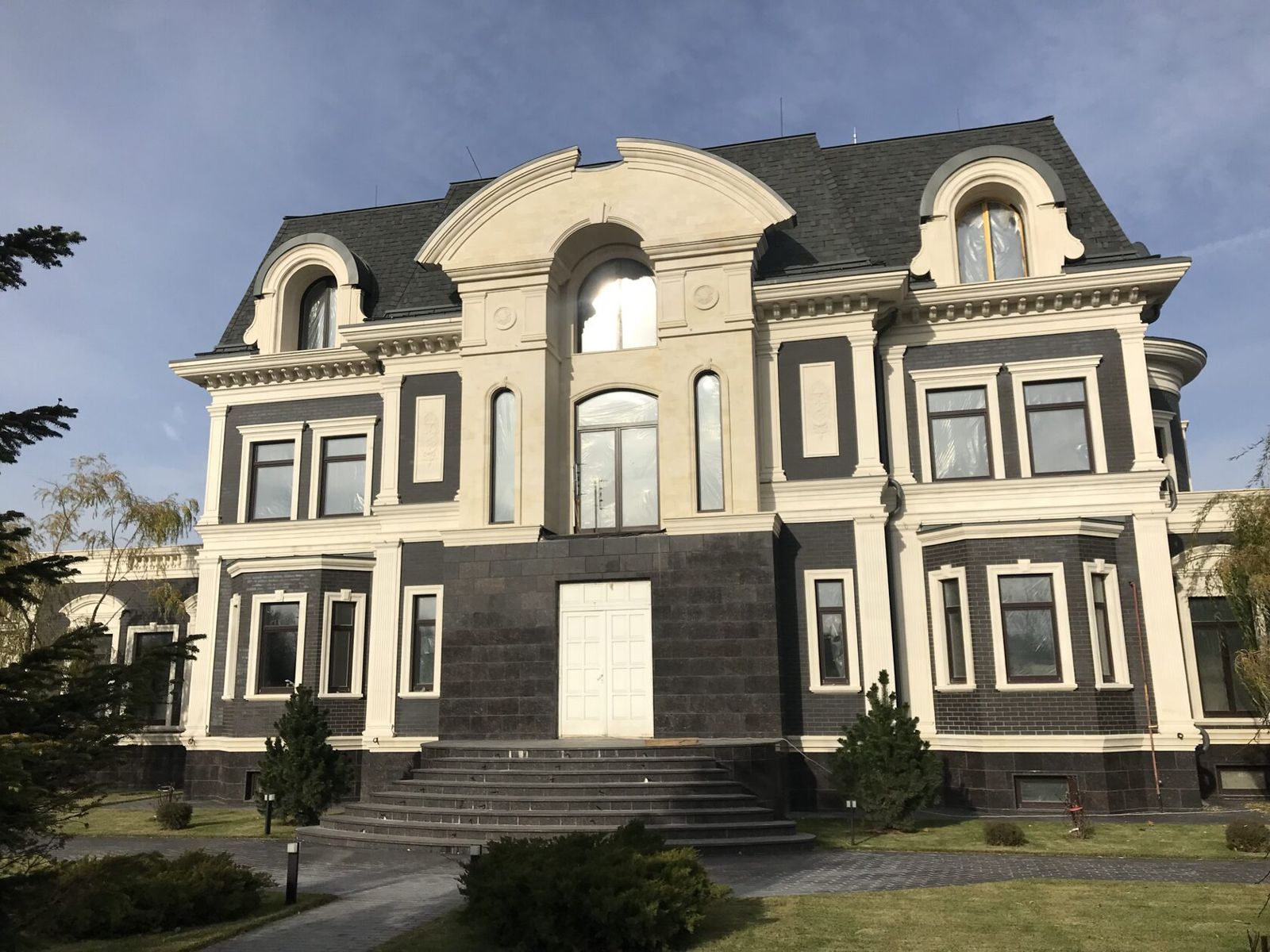
An example of natural stone on the company's projects is the Dinastiya club house in Kislovodsk: 700 m² of granite combined with 6,000 m² of glass fibre reinforced concrete (GFRC) and 700 m² of porcelain stoneware. Granite is used here where strength and wear resistance are needed, while GFRC provides the modelling of the facade. TECHNOFORMA carried out design and installation in 2024–2025.
Other projects are in TECHNOFORMA projects. How stone is fixed to a wall is covered in Natural stone facade cladding: installation methods.
FAQ
Which natural stone is best for facade cladding?
Granite or basalt for plinths and steps. For walls, granite, dense limestone, dolomite, travertine or sandstone with confirmed frost resistance. The choice is made on the basis of test reports for the specific quarry.
Which volcanic stone is traditionally used for facade cladding?
Tuff, a volcanic rock traditionally used for cladding, especially in Armenia.
Which stone should be used to clad a foundation from outside?
Dense, frost-resistant stones with low water absorption: granite, basalt, dolomite. The plinth gets the wettest and takes the most knocks.
How does natural stone cladding differ from stone-effect panels?
Natural stone is a natural material with a unique pattern and a long service life, but it is heavier and more expensive. Stone-effect panels are lighter and cheaper but are an imitation; a highly mouldable alternative is glass fibre reinforced concrete with a stone texture.
Can I order a stone that is not in stock?
Yes. In addition to its stock from India, Turkey, China and Iran, TECHNOFORMA supplies stone to order from anywhere in the world.