GOST Standards and Codes for GFRC
The main national standard for glass fibre reinforced concrete (GFRC) products in Russia is the Russian standard GOST R 58757-2019, which manufacturers and designers refer to; before applying it, check its status and current edition in the official standards register. In addition, GFRC products are covered by general standards for concrete and its test methods, and facades as a whole by codes of practice (SP) on loads, fire safety and rainscreen facade systems.
The main criterion for the client is not the standard number in a presentation but the documents for the specific product: the technical specifications (TU) or standard under which it is manufactured, the product data sheet and test reports. These are what confirm strength, frost resistance and fire performance.
This article is useful for designers, technical supervision and procurement teams. General information on the material is in GFRC: material and technology.
Which documents apply
The regulatory framework for GFRC can be divided into four levels:
| Level | What it regulates | Examples |
|---|---|---|
| Product standard | Classification, requirements, acceptance and inspection rules for GFRC products | Russian standard GOST R 58757-2019 (check status) |
| Standards for concrete and test methods | Strength, frost resistance, water absorption, density | Interstate (CIS) GOST standards for concrete and its testing |
| Design codes of practice | Loads and actions, fibre-reinforced concrete structures, rainscreen facades | Current Russian codes of practice (SP) on loads, fibre-reinforced concrete and rainscreen facade systems |
| Fire regulations | Combustibility of materials, fire hazard of facade systems | Russian Technical Regulation on fire safety requirements and related standards |
A manufacturer may also produce under its own technical specifications (TU), provided they do not contradict mandatory requirements. In that case the TU number is stated in the contract and product documentation, and the client is entitled to request them for review.
Rainscreen facade systems that use GFRC panels on multi-storey buildings are certified separately: such systems require a technical fitness assessment and fire testing of the system as a whole, not just the cladding. So a search for a "ventilated facade GOST" usually leads not to one standard but to a set of documents for the substructure, the cladding and the assembled system.
Material requirements
Standards and TU for GFRC products usually set requirements for the following characteristics:
• flexural strength — the key indicator for thin-walled products; the limit of proportionality and modulus of rupture are specified;
• compressive strength;
• frost resistance — a grade based on the number of freeze-thaw cycles;
• water absorption and density;
• glass fibre content — fibre proportion and type (alkali-resistant);
• geometry — tolerances on dimensions, flatness and edge straightness;
• appearance — permissible voids, chips and colour deviations against the reference sample;
• fire performance — combustibility group.
Specific numerical values depend on the product class and mix design and are set in the project and manufacturer's documents. According to TECHNOFORMA, its GFRC consists of four components — glass fibre, sand, high-grade cement and water — is non-combustible (Russian class NG) and has high frost resistance that is improved with admixtures. Exact values are stated in the product data sheet and test reports.
Testing and test reports
GFRC quality control is carried out at two levels:
1. Factory production control — every shift and batch: checking batching and fibre content, testing control samples taken from the same mix and made the same way as the products, checking geometry and appearance after demoulding.
2. Periodic and type testing — frost resistance, water absorption, long-term properties. These are carried out in accredited laboratories on a schedule or when the mix design changes.
The result is documented in a test report stating the laboratory, method, samples and values obtained. At acceptance, it is important to check that the report relates to the same mix design and type of product being delivered to site, and that it is not out of date.
For the facade as a whole, besides testing the cladding, the fixing calculation and on-site pull-out tests of anchors in the substrate are essential: their results determine the choice of anchors and bracket spacing.
Certificates
Certification of GFRC products in Russia is mainly voluntary: a manufacturer may obtain a certificate of conformity to a GOST or TU within a voluntary certification scheme. For facades, confirmation of the fire safety of materials and systems is mandatory in the cases set by law.
What is important to understand:
• a certificate confirms conformity of a product to a specific document — so check which one (GOST, TU) and for which product it was issued;
• a certificate has a validity period and an issuing body — all of this can be checked in registers;
• a fire certificate or test report for a material does not replace confirmation for the assembled facade system if one is required for the project.
Please request the numbers and validity dates of specific certificates for TECHNOFORMA products from your manager: publishing them without an up-to-date check would be incorrect.
What to request from a supplier
Documents worth requesting from a GFRC supplier before signing a contract:
1. The regulatory document under which the product is manufactured: GOST or TU (number and copy).
2. Test reports for flexural and compressive strength, frost resistance, water absorption.
3. Documents on the fire performance of the material.
4. Product data sheet or a sample batch certificate.
5. Composition details: glass fibre type and content.
6. A fixing calculation, or confirmation that it will be carried out as part of the design.
7. A reference sample for colour and texture with an agreed tolerance.
8. Maintenance guidelines and recommendations for water-repellent treatment.
Acceptance rules are recorded separately in the contract: the number of elements checked for geometry, the rejection procedure, and packaging and on-site storage requirements.
Examples from TECHNOFORMA projects
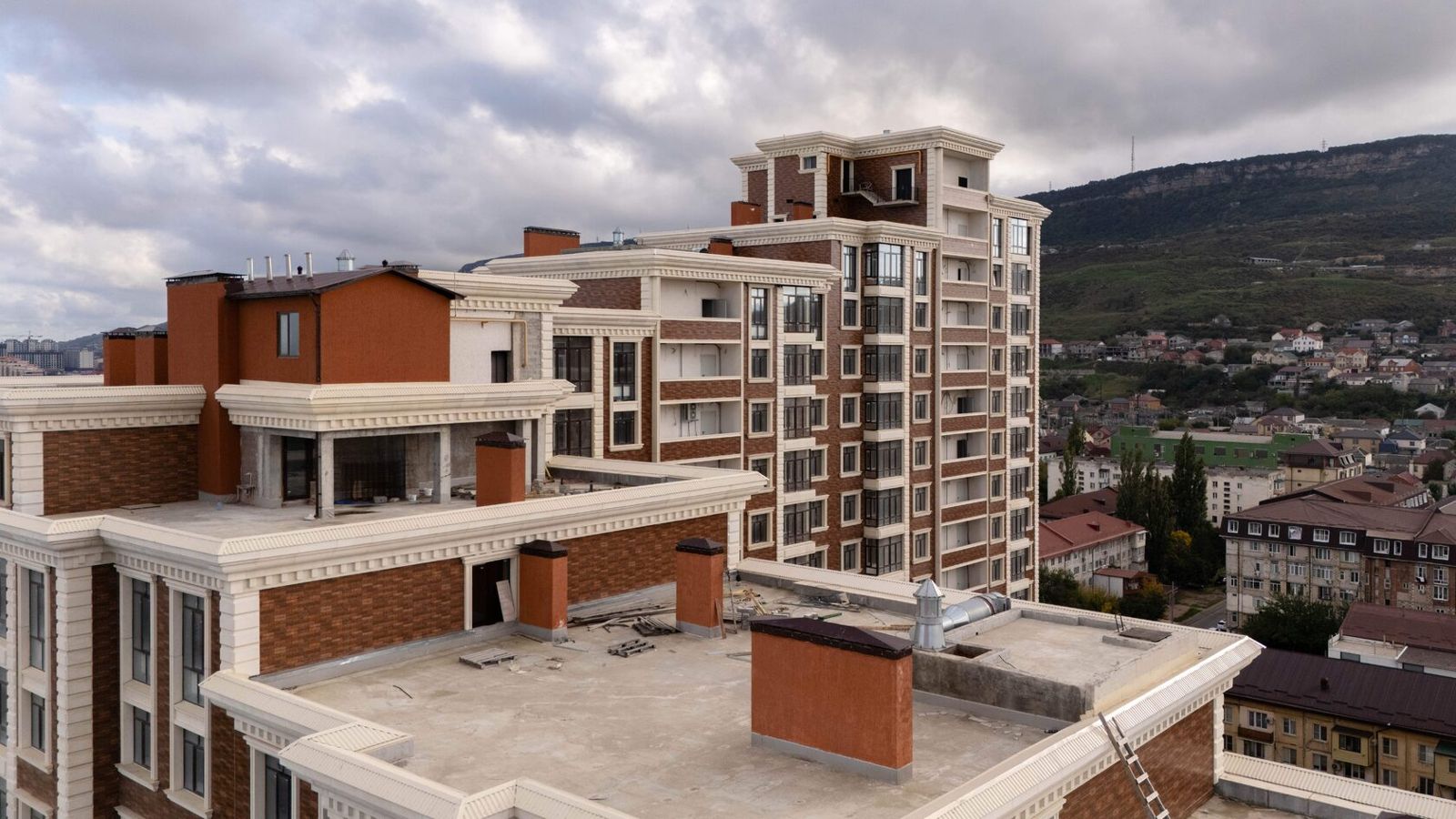
On large projects, product documents go through expert review together with the design. For example, TECHNOFORMA carried out design and installation supervision of 12,000 m² of GFRC cladding on the building of Chechen State University in Grozny, and at the Al-Qasr hotel complex in Dagestan — design and installation of 24,000 m² of GFRC.
More projects are in the TECHNOFORMA projects section. For how the technology and regulation developed, see The history of GFRC and its use worldwide.
FAQ
Which GOST applies to GFRC?
GFRC products refer to the Russian standard GOST R 58757-2019; check its status and edition before applying it. Products may also be made under the manufacturer's TU.
Is there a code of practice (SP) for GFRC?
Design follows current Russian codes of practice for fibre-reinforced concrete structures, loads and rainscreen facade systems; current edition numbers should be checked in the standards register.
Which GOST applies to ventilated rainscreen facades?
There is no single standard: the substructure, cladding and assembled system are confirmed by separate documents, including fire tests.
Which requirements matter for GFRC on a facade?
Flexural strength, frost resistance, water absorption, fibre content, geometry and combustibility group.
What documents should I request from a GFRC supplier?
GOST or TU, test reports, fire documents, product data sheet, fixing calculation and a reference sample.
Is there a GOST for shell limestone (coquina)?
As a natural stone, shell limestone falls under standards for cladding and walling stone from rock; this is a separate regulatory framework from GFRC.