GFRC Properties: Strength, Density, Frost Resistance
The properties of glass fibre reinforced concrete (GFRC) are described by several indicators: flexural and compressive strength, density, water absorption, frost resistance and combustibility. Flexural strength is what sets GFRC apart from ordinary concrete: it comes from alkali-resistant glass fibre, which is why element walls can be thin.
Specific values depend on the mix design, the forming method and the age of the samples, so manufacturers should be compared on test reports rather than advertising figures. According to TECHNOFORMA Group, its GFRC is non-combustible (class NG under the Russian classification) and has high frost resistance, further improved by admixtures.
This article is for designers, technical supervision and clients who need to know which figures to ask for. A general overview is in GFRC: material and technology.
Key performance figures
Below are indicative ranges typical for the industry. Values depend on the mix design and technology; exact data are in the product data sheet and the test report.
The indicators are interrelated. A dense matrix with a low water-cement ratio gives high compressive strength, low water absorption and good frost resistance at the same time. Fibre content and orientation have the greatest influence on flexural strength and on how the element behaves after the first crack. So when comparing manufacturers, look at a set of figures from one test report rather than a single favourable number.
| Indicator | Typical range | Depends on |
|---|---|---|
| Density | about 1,900–2,200 kg/m³ | Composition, degree of compaction |
| Flexural strength (modulus of rupture) | around 15–30 MPa for spray-up, lower for vibration casting | Fibre content and orientation, age |
| Compressive strength | around 40–80 MPa | Cement, water-cement ratio |
| Water absorption | a few percent by weight | Matrix density, admixtures |
| Frost resistance | high; the exact grade is set by testing | Mix design, admixtures, water absorption |
| Combustibility | NG (non-combustible), according to the company | Mineral composition |
| Wall thickness | usually 10–20 mm | Forming method, element size |
Four groups of factors have the strongest effect on the final properties: the mix design (cement grade and content, water-cement ratio, polymer admixtures, sand fraction), fibre content and length, the forming method and the curing conditions — the moisture regime during the first day, when the matrix gains strength and bond with the fibre develops. An element that dries out in the first hours can have noticeably lower flexural strength than properly cured samples of the same mix.
| Forming method | Reinforcement | Typical property features | Where used |
|---|---|---|---|
| Spray-up | chopped fibre oriented in the plane of the layer, higher content | highest flexural strength; thin wall; quality depends on operator skill and thickness control | large panels, column casings, large-section cornices |
| Vibration casting (premix) | fibre mixed into the batch, random orientation, lower content | lower flexural strength than spray-up; stable geometry and good reproduction of fine relief | small and medium ornament, capitals, brackets, balusters |
| Combined | face coat without fibre or with little fibre, then a reinforced backing layer | clean face with no protruding fibres; properties governed by the reinforced layer | elements with demanding surface texture requirements |
The assessments in the table are general and comparative; only a test report gives specific figures for each method and mix design.
Flexural and compressive strength
GFRC strength is described by two groups of indicators. Compressive strength is governed by the cement matrix and is close to that of high-grade fine-grained concretes. For cladding it is rarely critical: a panel carries no vertical load from the building.
Flexural strength is the key figure for facade elements. A panel is subject to wind load, its own weight between fixing points and thermal movement. For GFRC two values are distinguished: the limit of proportionality (the stress up to which the material behaves elastically, without cracks) and the modulus of rupture (the failure stress). The latter is provided by the fibres, which hold the crack together and prevent brittle failure.
Age also matters: GFRC flexural strength can decrease over the years, so calculations use long-term values with safety factors rather than initial ones. This is addressed by alkali-resistant fibre, admixtures and a correct mix design.
How flexural strength is measured. Strip specimens are cut from a control board formed together with the production batch by the same method and tested in bending, usually in a four-point arrangement. The load–deflection curve gives the limit of proportionality (first crack) and the modulus of rupture. For sprayed material, specimens are tested in two directions and loaded on both the face and the back side, because fibre orientation and variation through the thickness make a difference.
What this means for a project:
• wall thickness and stiffening ribs are selected by calculation from long-term flexural strength and the wind load for the specific location and height;
• fixing spacing and panel size are linked: the longer the span between supports, the higher the bending stresses;
• working stresses are kept below the limit of proportionality so that no cracks appear in service; the margin up to the modulus of rupture is a reserve for overloads;
• large flat panels are often stiffened with a steel frame on flexible anchors that do not restrain thermal and moisture movement of the skin.

Frost resistance and water absorption
The frost resistance of GFRC is its ability to withstand repeated freezing and thawing when saturated with water without losing strength or surface damage. It is directly linked to water absorption: the denser the matrix and the fewer open pores, the less water enters the material and the lower the internal ice pressure.
According to TECHNOFORMA Group, its GFRC has high frost resistance, improved with admixtures. In practice resistance is increased by:
• a low water-cement ratio and plasticisers;
• polymer and air-entraining admixtures;
• water-repellent treatment of the face;
• correct details that prevent water standing on horizontal elements (drips, falls on cornices).
Trade names of admixtures and products for winter concreting that turn up in search results have nothing to do with the frost resistance of a finished element: a frost resistance grade is confirmed only by testing specimens.
Besides frost resistance, durability is affected by shrinkage and moisture movement: the cement matrix changes size as it dries and gets wet, and in thin-walled elements this is more noticeable than in mass concrete. If a panel is rigidly restrained around its perimeter, this movement creates stresses and cracks. So fixings are designed with sliding supports, and panel sizes and joint widths allow for movement.
Typical mistakes that make a material frost-resistant on paper fail on the facade:
• horizontal surfaces without falls, where water stands and freezes;
• no drip grooves on projecting elements, so water runs onto the soffit and the back face;
• open cavities and ends where snow packs in;
• joint sealant not designed for the movement, so water gets behind the cladding through tears;
• de-icing salts at plinths and steps; for these zones frost resistance is tested in a salt solution, not only in water.
Fire performance
GFRC consists of mineral components — cement, sand, glass fibre and water — so according to the company it belongs to combustibility class NG (non-combustible). This is an important difference from polyurethane, polymer and expanded polystyrene mouldings.
For multi-storey residential buildings, public buildings and hotels, requirements for the combustibility of cladding and rainscreen systems are set by the applicable fire safety codes (in Russia, sets of rules SP). Non-combustible cladding makes these requirements easier to meet, but the fire safety of the facade as a whole is determined by the entire system: insulation, substructure, wind barrier and fire breaks. So the system must be assessed, not just the panels.
When heated, GFRC does not melt, produce burning droplets or support combustion. Under prolonged high-temperature exposure, like any cementitious material, it gradually loses strength and the surface may crack. For facades this means that GFRC elements do not spread fire across the cladding, but their fixings and substructure must also meet the design requirements.
How to verify declared properties
Declared properties are a promise; documents and tests confirm them. What to request from the manufacturer:
1. Test reports for flexural and compressive strength, density, water absorption and frost resistance, with the date, laboratory and specimen description.
2. A product data sheet or the technical specifications the products are made to.
3. Fibre documentation confirming alkali resistance.
4. Combustibility data for the material.
5. Control specimens from your batch, which can be tested in an independent laboratory.
The same approach works for any facade material. The properties of shell limestone (coquina) blocks or travertine depend on the deposit and the specific batch: density, strength and water absorption can differ markedly between two quarries of the same stone. Insulation properties (for example, mineral wool facade boards) are taken from the manufacturer's technical documentation for the specific product. In every case compare figures in documents, not in advertising.
Which properties matter for which elements is easy to check in the table, so you request exactly what affects your project.
| Element or zone | Critical indicators | What to watch |
|---|---|---|
| Large facade panels at height | flexural strength (long-term), density | wind calculation, sliding fixing layout |
| Cornices, window pediments, string courses | frost resistance, water absorption | falls, drip grooves, protection of top surfaces |
| Plinths, steps, parapets by pavements | frost resistance in salt, impact resistance | de-icing salts, mechanical damage |
| Cladding of multi-storey and public buildings | combustibility, strength | requirements for the rainscreen system as a whole |
| Column casings, curved elements | flexural strength, dimensional stability | forming method, wall thickness |
Typical mistakes when comparing offers: comparing flexural strength of specimens of different ages; setting spray-up figures from one supplier against cast figures from another; accepting data for "the material in general" instead of reports on the products that will go to site; not checking that specimens were made by the same method as the elements. If a report does not state the forming method, specimen age and curing conditions, it is almost useless for comparison.

Examples from TECHNOFORMA projects
At RUBLEVO BUSINESS PARK in Moscow the company carried out facade design and installation: 15,000 m² of GFRC and 5,000 m² of FRONTEK on two 12-storey buildings. For an office centre in Moscow, both wind loads at height and freeze–thaw cycles in the shoulder seasons matter.
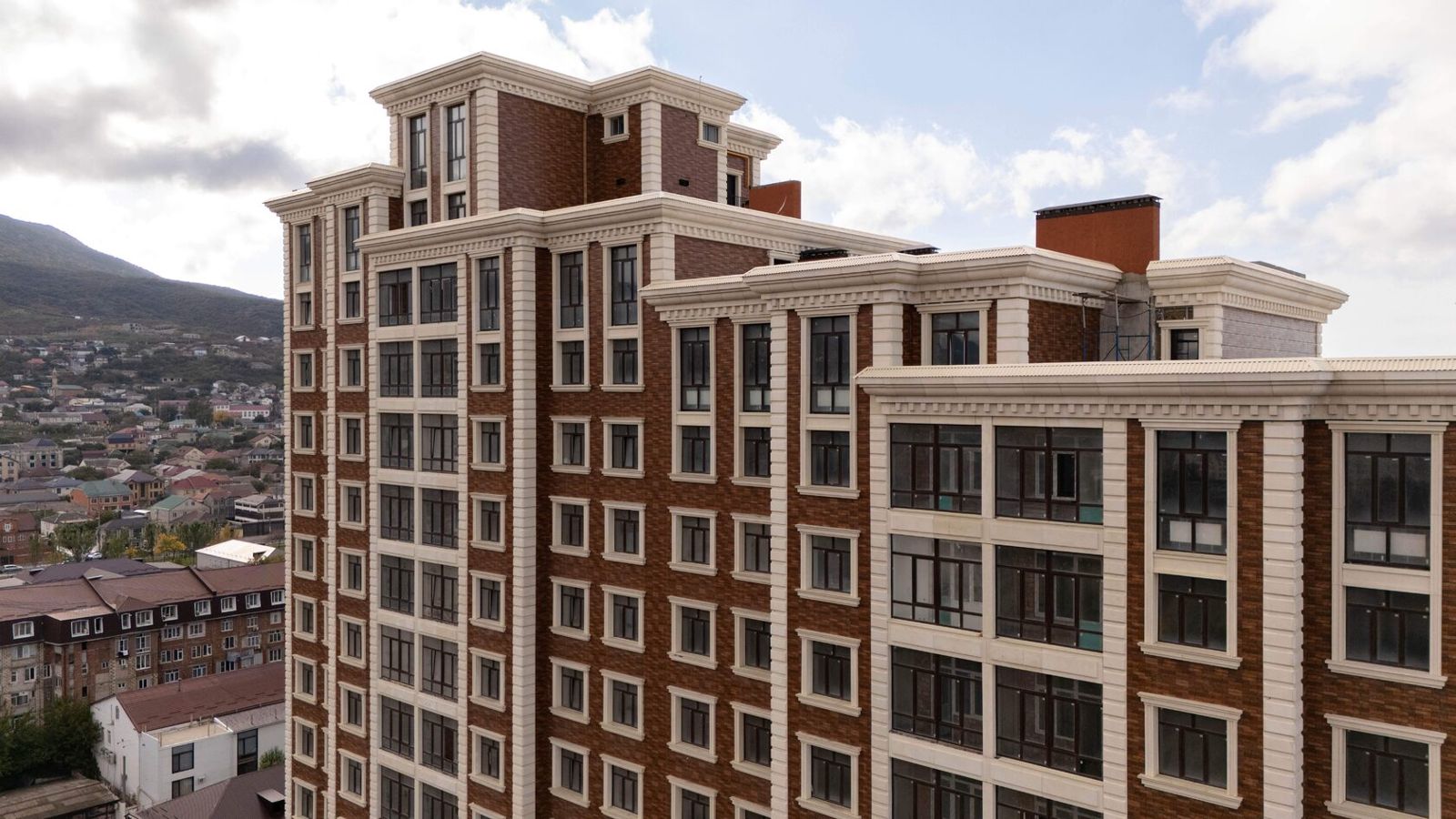
At Triumph residential complex in Makhachkala — 11,500 m² of GFRC, completed in 2021. More projects are in TECHNOFORMA projects. How density turns into load on the facade is covered in How much GFRC weighs and how it affects facade loads.
FAQ
What is the density of GFRC in kg/m³?
Usually about 1,900–2,200 kg/m³, depending on composition and degree of compaction. The exact value is stated in the test report for the specific mix design.
How strong is GFRC?
Flexural strength of sprayed GFRC is roughly 15–30 MPa, compressive strength 40–80 MPa. Values depend on the mix design, forming method and specimen age.
How frost-resistant is GFRC?
Highly: a dense matrix with low water absorption tolerates freeze–thaw cycles well. The specific frost resistance grade is confirmed by testing specimens.
Does GFRC burn?
No. According to TECHNOFORMA Group, its GFRC belongs to combustibility class NG — non-combustible.
How do I check a manufacturer's GFRC properties?
Request specimen test reports, the product data sheet and documents for the alkali-resistant fibre, and if necessary test control specimens from your batch in an independent laboratory.
How do the properties of sprayed and cast GFRC differ?
Spray-up gives a higher fibre content oriented in the plane of the element, so flexural strength is usually higher. Casting (premix) is better for fine relief and stable geometry, but its flexural strength is generally lower. Exact values depend on the mix design and are given in the test report.