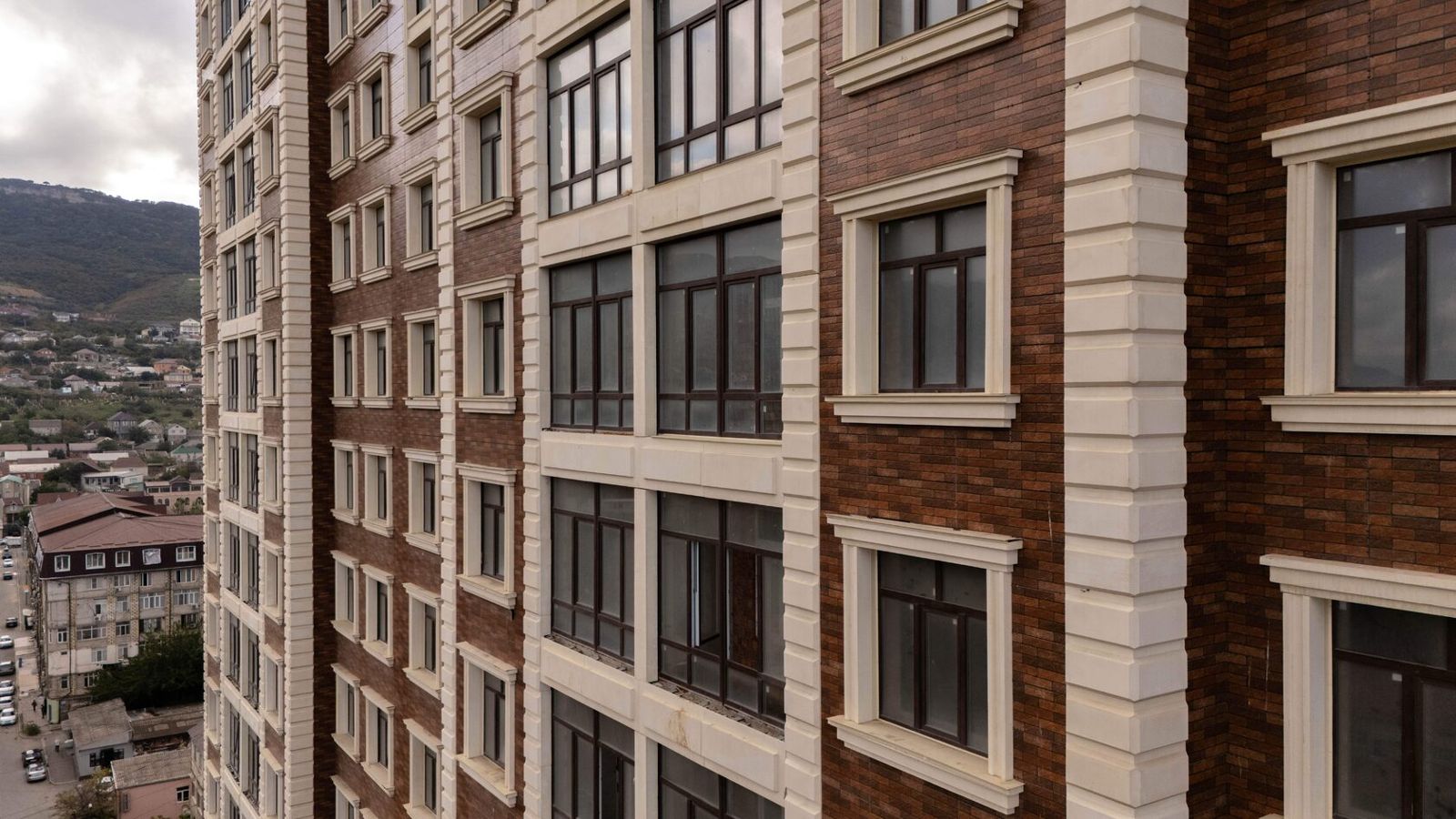
GFRC Composition: Cement, Sand and Alkali-Resistant Fibre
Glass fibre reinforced concrete (GFRC) consists of four basic components: cement, fine sand, alkali-resistant glass fibre and water. Plasticisers and modifying admixtures are added to control the workability of the mix, the rate of strength gain and frost resistance.
The key component is the fibre: it must be alkali-resistant, otherwise the cement environment gradually destroys it and the element loses flexural strength. So when choosing a supplier, the question is not just what goes into the mix, but which materials the manufacturer actually uses, in what proportions, and how it controls them.
This article is for architects, technical supervision engineers and clients comparing offers from GFRC manufacturers. For a general overview of the material, see GFRC: material and technology.
Mix components
According to TECHNOFORMA Group, its GFRC is made from four components. The role of each:
| Component | Role in the material | What to look for |
|---|---|---|
| High-grade cement | Binder; forms the matrix and compressive strength | Grade and batch-to-batch consistency; white cement is used for light-coloured and through-coloured elements |
| Sand | Aggregate; reduces shrinkage and forms the surface texture | Fine fraction, free of clay and silt particles |
| Alkali-resistant glass fibre | Dispersed reinforcement; carries bending and tension, provides crack resistance | Fibre type (zirconia-containing AR glass), length and proportion by weight |
| Water | Cement hydration, workability of the mix | Low water-cement ratio; excess water reduces strength |
Unlike ordinary concrete, GFRC contains no coarse aggregate such as crushed stone or gravel. This makes thin walls possible and allows the mould relief to be reproduced sharply.
In industry practice, the requirements for the components come down to a few points. Cement: high-grade Portland cement without mineral additions that reduce early strength; for light-toned architectural elements, white Portland cement. Sand: graded quartz sand, usually with a maximum grain of about 1–2 mm, washed and dried, because sand moisture directly changes the actual water-cement ratio. Water: drinking quality or meeting the requirements for concrete mixing water, free of salts and organic matter that cause efflorescence and stains on the face.
Besides the base components, the mix may include pigments, decorative fillers (marble or granite chips for a textured face layer), polymer dispersions and pozzolanic additives. Their share is small, but they largely determine the appearance and durability of a particular element.
Why alkali-resistant glass fibre is essential
Hardened cement paste is a highly alkaline environment. Ordinary glass (E-glass) corrodes in it over time: the fibres lose strength and the element gradually becomes brittle. That is why GFRC uses alkali-resistant glass fibre (AR glass) containing zirconium dioxide. This fibre is what distinguishes GFRC from any mix that simply has 'glass fibre for concrete' added.
There is no universal answer to what GFRC is made of and in what proportions. In industry practice, fibre content is usually a few per cent of the mix weight (roughly 3–5% for spray-up and less for vibration casting), the cement-to-sand ratio is close to 1:1 and the water-cement ratio is low, around 0.3–0.4. The actual mix design depends on the forming method, the required properties and the manufacturer's materials; exact values are set out in the production procedure and confirmed by test reports.
Fibre comes as roving (a continuous strand chopped by the spray gun during spray-up) or as ready-made chopped fibre for premix. Fibre length is usually measured in centimetres and chosen to suit the production method.
The table shows indicative proportions found in industry practice. This is not a recipe for DIY production but an order of magnitude that helps compare offers; actual values depend on the manufacturer's materials and equipment.
| Parameter | Spray-up | Vibration casting / premix |
|---|---|---|
| Cement : sand (by weight) | about 1:1 | 1:1 to 1:1.5 |
| Water-cement ratio | 0.30–0.38 | 0.30–0.40 with superplasticiser |
| AR fibre content by mix weight | roughly 4–5% | roughly 2–3% |
| Fibre length | chopped roving, usually 25–40 mm | ready-made fibre, usually 6–13 mm |
| Polymer dispersion (solids by cement weight) | a few per cent, if used | a few per cent, if used |
How much fibre to add is determined by the required flexural strength and the technology. In spray-up the fibre lies in the plane of the element and works more efficiently, so its share is higher and the wall is thinner. In premix the fibre is distributed randomly throughout the volume, and with too much fibre the mix loses workability, forms lumps and fills the mould relief poorly. Raising fibre content above the optimum does not give a proportional gain in strength, but it makes the element more expensive and worsens the surface.

Admixtures and plasticisers
Admixtures do not replace the main components; they adjust the properties of the mix and the finished element:
• Plasticisers and superplasticisers reduce the amount of water without loss of workability. Less water means higher density and strength and lower water absorption.
• Polymer additives (for example, acrylic dispersions) improve curing conditions for thin walls, increase crack resistance and reduce water absorption.
• Frost-resistance admixtures: according to TECHNOFORMA, the frost resistance of GFRC is improved with admixtures, which is especially important in climates with frequent freeze-thaw transitions.
• Pigments for through-colouring; dosed strictly so as not to reduce strength.
• Pozzolanic additives (for example, metakaolin, silica fume) bind part of the free lime and lower the alkalinity of the matrix, giving the fibre additional protection.
The set and dosage of admixtures are part of the manufacturer's mix design, so they are worth discussing when approving elements.
For facade elements, three groups of admixtures matter most: those that reduce water absorption (integral water repellents and polymers), those that increase frost resistance, and those that protect the fibre from the alkaline environment. For interior elements, pigments and admixtures that improve surface quality come to the fore.
| Admixture | What it gives | Risk of overdosing |
|---|---|---|
| Superplasticiser | Less water at the same workability | Segregation of the mix, delayed setting |
| Acrylic dispersion | Crack resistance, curing without wet care, lower water absorption | Higher cost, lower compressive strength |
| Metakaolin, silica fume | Denser matrix, fibre protection, less efflorescence | Higher water demand of the mix |
| Pigments | Through-colouring | Lower strength, uneven colour |
| Integral water repellent | Less capillary suction | Poorer bond between layers |
Mineral pigments are used: iron, chromium and titanium oxides, which resist the alkaline environment and UV. Their dosage is usually limited to a few per cent of the cement weight: above that the gain in colour saturation is minimal and strength starts to drop. Decorative fillers such as marble, granite or quartz chips go into the face layer, which is then acid-etched or sandblasted to expose the grain.
How composition affects strength
The strength of GFRC depends not on a single component but on their balance:
• Fibre content and distribution are the main factors in flexural strength. Too little fibre reduces crack resistance; too much makes placing harder and can form lumps.
• Water-cement ratio: the lower it is while keeping workability, the denser and stronger the matrix.
• Sand quality: contaminated or overly coarse sand weakens the bond with the fibre and worsens the surface.
• Compaction: in spray-up the layers are rolled; in vibration casting the mix is compacted by vibration; air voids reduce strength.
• Curing regime: thin elements lose moisture quickly, and without humidity control they do not reach full strength.
For comparison, the properties of natural materials are set by their mineral composition. Shell limestone (coquina), for example, is a limestone composed mainly of calcite from shells, and its strength depends on the porosity of the particular quarry. With GFRC, strength can be designed through the mix. In a ventilated rainscreen facade, the GFRC panel is only the cladding layer; the system also includes the substructure, fixings, insulation and wind barrier, and the strength of the whole assembly is determined by calculating the connections.
How the composition shows up in the properties of the finished element is summarised in the table. The numerical properties of GFRC depend on the mix design and technology; exact values are given in the product data sheet and test reports.
| Property | What determines it in the mix | How it is tested |
|---|---|---|
| Flexural strength | Fibre content, length and orientation, w/c ratio | Testing coupons cut from control boards |
| Frost resistance | Matrix density, admixtures, water absorption | Freeze-thaw cycles using concrete test methods |
| Water absorption | W/c ratio, polymers, pozzolans, compaction | Saturating specimens with water |
| Crack resistance and shrinkage | Cement-to-sand ratio, curing regime | Inspection of elements, deformation monitoring |
| Long-term ductility | Fibre type, pozzolanic additives | Accelerated ageing tests |
The main difference from ordinary concrete is how it works in tension. In heavy concrete, tension is taken by steel reinforcement, and the concrete itself cracks early in bending. In GFRC, the dispersed fibre takes tensile stresses throughout the volume, so a wall 10–20 mm thick carries a load for which ordinary concrete would need several times the thickness plus a reinforcement cage with cover.
What to ask the manufacturer about the mix design
Before ordering elements, it is worth asking the manufacturer a few specific questions:
1. What glass fibre is used: alkali-resistant AR fibre, who makes it, and is it documented?
2. What is the fibre content by weight and which forming method is used (spray-up, vibration casting, premix)?
3. What cement and sand are used, and how is batch consistency controlled?
4. Which admixtures are added for frost resistance and lower water absorption?
5. Are control specimens made from every batch, and are there test reports for flexural strength, frost resistance and water absorption?
6. How is curing of thin-walled elements organised?
TECHNOFORMA Group controls quality at every production stage and makes its own models and moulds in its in-house mould shops. Specific properties of elements for a project are discussed with the company's engineers.
Typical client mistakes when assessing composition:
• comparing manufacturers only by price per square metre without requesting flexural and frost resistance test reports;
• taking fibre documents as documents for the element: a certificate for AR glass does not confirm that the right amount goes into the mix;
• approving colour from a single sample without checking elements from different batches;
• not specifying in the contract that control specimens are made and kept until acceptance;
• accepting a change of forming method (spray-up to premix) without recalculating thickness and cast-in fixings.
A separate issue is storing elements before installation. Finished elements are stored on timber bearers in a position close to their design position and protected from direct soaking and dirt. Chips are repaired with repair mortars colour-matched to the matrix, which is one more reason to know the element's composition.

Examples from TECHNOFORMA projects
At the Anzhi-City residential complex in Makhachkala (16 storeys), the company designed and installed 18,000 m² of GFRC facades. At the Al-Qasr hotel complex in Dagestan it supplied 24,000 m² of GFRC across four 11-storey buildings. At such volumes, batch-to-batch consistency matters as much as the mix design itself: elements must match in colour, texture and strength.
More projects are in the TECHNOFORMA projects section. How the mix becomes an element is explained in GFRC production technology: spray-up and vibration casting.
FAQ
What is GFRC made of?
Cement, fine sand, alkali-resistant glass fibre and water, plus plasticisers and modifying admixtures. GFRC contains no coarse aggregate (crushed stone).
What are typical GFRC mix proportions?
The cement-to-sand ratio is usually close to 1:1, fibre content is a few per cent of the mix weight and the water-cement ratio is low. Exact proportions depend on the technology and are set out in the manufacturer's production procedure.
Can ordinary glass fibre be used in concrete?
Not for durable elements. Ordinary glass breaks down in the alkaline cement environment; GFRC uses alkali-resistant fibre containing zirconium dioxide.
Why are plasticisers added to GFRC?
They reduce the amount of water while keeping the mix workable, which increases density and strength and lowers water absorption.
What does a ventilated facade with GFRC panels consist of?
Substructure brackets and rails, fixings, insulation, a wind barrier membrane where needed, and GFRC cladding panels installed with a ventilated cavity.
How much glass fibre goes into GFRC?
In industry practice, roughly 4–5% of the mix weight for spray-up and 2–3% for vibration casting and premix. The exact share depends on the required strength and technology and is set in the manufacturer's procedure.