Service Life of GFRC on Facades
The service life of glass fibre reinforced concrete (GFRC) on a facade is measured in decades and is determined not by one parameter but by a combination: the quality of the alkali-resistant fibre and the mix, correct element and fixing design, drainage and maintenance. International experience with GRC spans more than half a century, and elements made to the proper technology are still in service.
The main durability factor is water: wherever it stands and freezes, any concrete deteriorates faster. So when choosing a manufacturer, look not only at specimen strength but also at how well falls, drips, joints and surface protection have been thought through.
This article is for clients, technical supervision and facility managers. Basic information about the material is in GFRC: material and technology.
What service life depends on
The service life of GFRC elements is affected by three groups of factors:
| Group | Factor | What to check |
|---|---|---|
| Material | Fibre type and content | Alkali-resistant glass fibre only, content as per mix design |
| Material | Water-cement ratio, admixtures | Test reports for strength, frost resistance, water absorption |
| Element | Thickness, ribs, cast-in fixings | Compliance with calculations and shop drawings |
| Element | Falls, drips | No horizontal surfaces where water can stand |
| Installation | Fixing scheme | Freedom for thermal movement, corrosion-resistant fixings |
| Service | Climate, aggressiveness of the environment | Sea salt, industrial emissions, freeze-thaw cycles |
Climate deserves separate mention. A southern climate with frequent freeze-thaw transitions and wet winters can be harder on a facade than steady frost. A sea coast adds chlorides, which are dangerous primarily for metal cast-in fixings and fasteners. All these conditions are taken into account when choosing the mix, the cover thickness and the material of the fixings.
Service life benchmarks usually quoted in the industry are shown below. These are not warranty commitments but estimates for comparing materials, assuming correct design, production and maintenance; the actual life depends on climate, design and care.
| Cladding | Indicative service life | What limits it |
|---|---|---|
| GFRC on mechanical fixings | decades; industry estimates from 50 years | Fibre and mix quality, drainage, fixings |
| Dense natural stone | many decades and longer | Fixings, frost resistance of porous stones |
| Porcelain stoneware on a rainscreen | decades | Life of the substructure and clips |
| Polyurethane or polystyrene decoration | usually considerably shorter | UV, coating, mechanical damage |
| External insulation render systems (ETICS) | 10–30 years before major repair | Cracks, wetting, workmanship |
| Plaster decoration outdoors | a few seasons | Softening and frost damage |
For the facade as a whole, service life is set by the weakest element of the system. GFRC cladding can outlast a galvanised steel substructure in an aggressive environment, or joint sealants that need replacing after 10–15 years. So the design life is set for the whole system, not just the cladding.
Ageing and carbonation
Two main processes take place in GFRC as it ages.
Ageing of the composite. Cement paste continues to hydrate, and hydration products gradually fill the spaces between the glass filaments in the strands. As a result, the ductility of the material, its ability to carry load after the first crack, decreases over time, and flexural strength approaches the limit of proportionality. The effect has long been known, so element design relies on long-term rather than initial properties, and modern mixes with modifying admixtures slow the process down.
Carbonation. Carbon dioxide in the air reacts with the calcium hydroxide in the cement paste, and the alkalinity of the surface layer drops. For glass fibre this is largely neutral, but for steel cast-in fixings located in a thin carbonated layer it means a risk of corrosion. That is why cast-in fixings and fasteners in GFRC are made of stainless or protected steel, and the cover is specified with a margin.
Both processes are slow and predictable; they are accounted for in design rather than fixed after installation.
The practical conclusion for the client: comparing suppliers by 28-day strength is not enough. A better question is how the mix design and calculations account for the long-term properties of the material, which fibre type is used and what steel the cast-in fixings are made of.
How water and frost destroy the concrete matrix: water that has entered the pores expands by about 9% on freezing, creating tensile stresses in the pore walls. Each cycle leaves micro-damage that accumulates. That is why a low water-cement ratio, a dense matrix and no places where the element stays saturated for long are important for durability. Dry concrete is not affected by frost; the damage comes from the combination of water and temperatures crossing zero.
The rate of carbonation depends on matrix density and moisture: the denser the material, the more slowly the carbonation front moves into the wall.
The role of water-repellent treatment
Water-repellent treatment is an impregnation that makes surface pores water-repellent while keeping the material vapour-permeable. It extends service life through three effects:
• the material becomes less saturated, so there is less freeze-thaw damage;
• salt migration is reduced, so there is less efflorescence and staining;
• the surface gets less dirty and is cleaned better by rain.
The effect of the impregnation declines over time under UV and rain, so it is renewed at intervals specified by the product manufacturer. The facade is cleaned before re-treatment, and on painted elements compatibility of the impregnation with the paint is checked.
Important: water-repellent treatment does not correct design mistakes. If water stands on the horizontal surface of a cornice or a joint lets it into the element, the impregnation will only slow the damage. Falls, drips and correct joints come first, surface protection second. Some products slightly deepen the colour of the element, so they are tested on a sample before treating the whole facade.
For painted elements, vapour-permeable facade paints (silicate, silicone, mineral-based acrylic) are used instead of or together with impregnation. Film-forming vapour-tight coatings are undesirable on GFRC: moisture that gets into the material cannot escape, and the coating blisters and peels. Painted facades need repainting at intervals that depend on the product and exposure, whereas through-coloured elements need no repainting.
Field experience
Worldwide experience with GFRC dates back to the 1970s; since then the material has been used on facades in different climate zones, from the United Kingdom to the Middle East. The conclusions the industry has drawn over this time:
1. Most problems are caused not by the material itself but by the design: rigid fixing that ignores movement, no drainage, insufficient thickness around cast-in fixings.
2. Production quality is decisive: the wrong fibre content, excess water and poor curing show up as cracks within the first few years.
3. Regular inspection makes it possible to spot local defects in time and fix them before they develop.
TECHNOFORMA handed over its first GFRC projects in 2017: the Golden Keys residential complex and the Bogatyreva residential complex in Makhachkala. The company has worked with the material for more than 10 years.
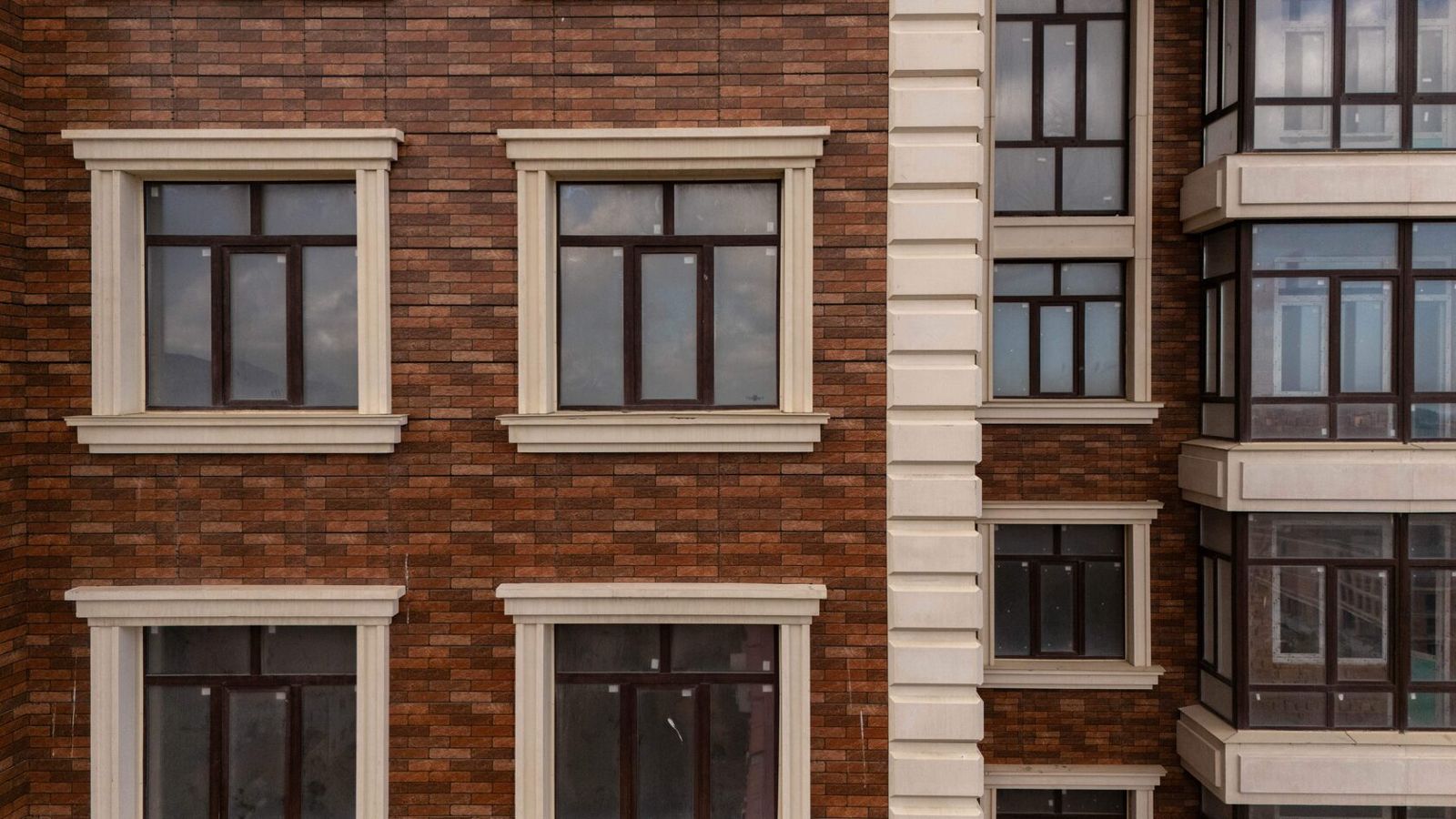
Typical signs on a facade worth looking for during inspection: hairline cracks near cast-in fixings and at corners, delamination of the textured layer, efflorescence and streaks below horizontal elements, traces of fixing corrosion, and failed sealant in joints. Most of them do not threaten safety if found in time and are dealt with by local repair.
Signs of a quality element that can be checked at acceptance, without waiting years of service:
• uniform wall thickness without thin spots, especially at ribs and corners;
• no voids or dry zones with unimpregnated fibre on the back face;
• cast-in fixings of stainless or protected steel, firmly embedded, with no cracks around them;
• consistent colour and texture within a batch and between batches;
• falls and drips built into horizontal faces;
• element marking and a data sheet with control specimen test results.
If even one of these points is not met, the defect is likely to show within the first few years rather than decades.
Why GFRC outlasts many alternatives under the same conditions: the mineral matrix does not fade in the sun or age under UV like polymer decoration; the material does not burn; and the absence of steel reinforcement rules out the main cause of failure in thin reinforced concrete, corrosion of steel with spalling of the cover. Service life is limited mainly by design decisions and workmanship, not by the material itself.
How to extend service life
The service life of a GFRC facade can be extended at every stage:
• Design: falls on top faces of at least a few per cent, drips, flashings, open or properly sealed joints, freedom for thermal movement, corrosion-resistant fixings.
• Production: consistent mix, control of fibre content, correct curing of elements.
• Installation: mounting without overstressing, protection from damage, closing top edges before the rains start.
• Service: inspecting the facade at least once a year and after strong winds, cleaning drainage, renewing water-repellent treatment and sealants, local repair of chips with repair mortars.
For systematic maintenance, as-built documentation is useful: a layout drawing with element marking and the fixing details. It speeds up finding and replacing a damaged element.
The facility manager should keep an inspection log with photographs: this makes it easier to track how a defect develops and decide whether to repair or replace an element. A replacement element is made in the same mould and colour-matched, so it makes sense to keep the moulds for standard elements.
Mistakes that most often shorten service life:
| Mistake | Consequence | How to avoid it |
|---|---|---|
| Horizontal top faces without a fall | Standing water, efflorescence, frost damage | Fall and drip built into the element |
| Rigid fixing at every point | Cracks from thermal movement | One fixed support, the rest sliding |
| Joints filled with mortar | Spalled edges, cracks | Open or elastic joints |
| Carbon steel in cast-in fixings | Corrosion, element burst by rust | Stainless or protected steel |
| Drilling and fixing signs on site | Cracks and leaks in the element | Fixing points provided in the design |
| High-pressure washing with abrasives | Damage to the surface layer | Gentle cleaning as recommended by the manufacturer |
| No inspections | A local defect turns into element replacement | Annual inspection and log |
Where GFRC elements last especially long: on vertical surfaces with good drainage, in areas without an aggressive industrial environment, with protected top faces. The most stressed zones are parapets, cornices and the plinth, where wetting and mechanical impact are higher; they are checked separately at the design stage.
Do GFRC elements need maintenance? Minimal: an annual inspection, cleaning of drainage and flashings, washing with low-pressure water without aggressive acid products, and renewing sealants and water-repellent treatment according to the manufacturers' schedules. Acid cleaners used to remove efflorescence from brick are dangerous for cement products: they dissolve the surface layer of the matrix and expose the fibre. Efflorescence on GFRC is removed with a dry brush once the surface has dried or with products approved for concrete. An element is replaced if a crack runs through the full wall thickness or a cast-in fixing has failed.
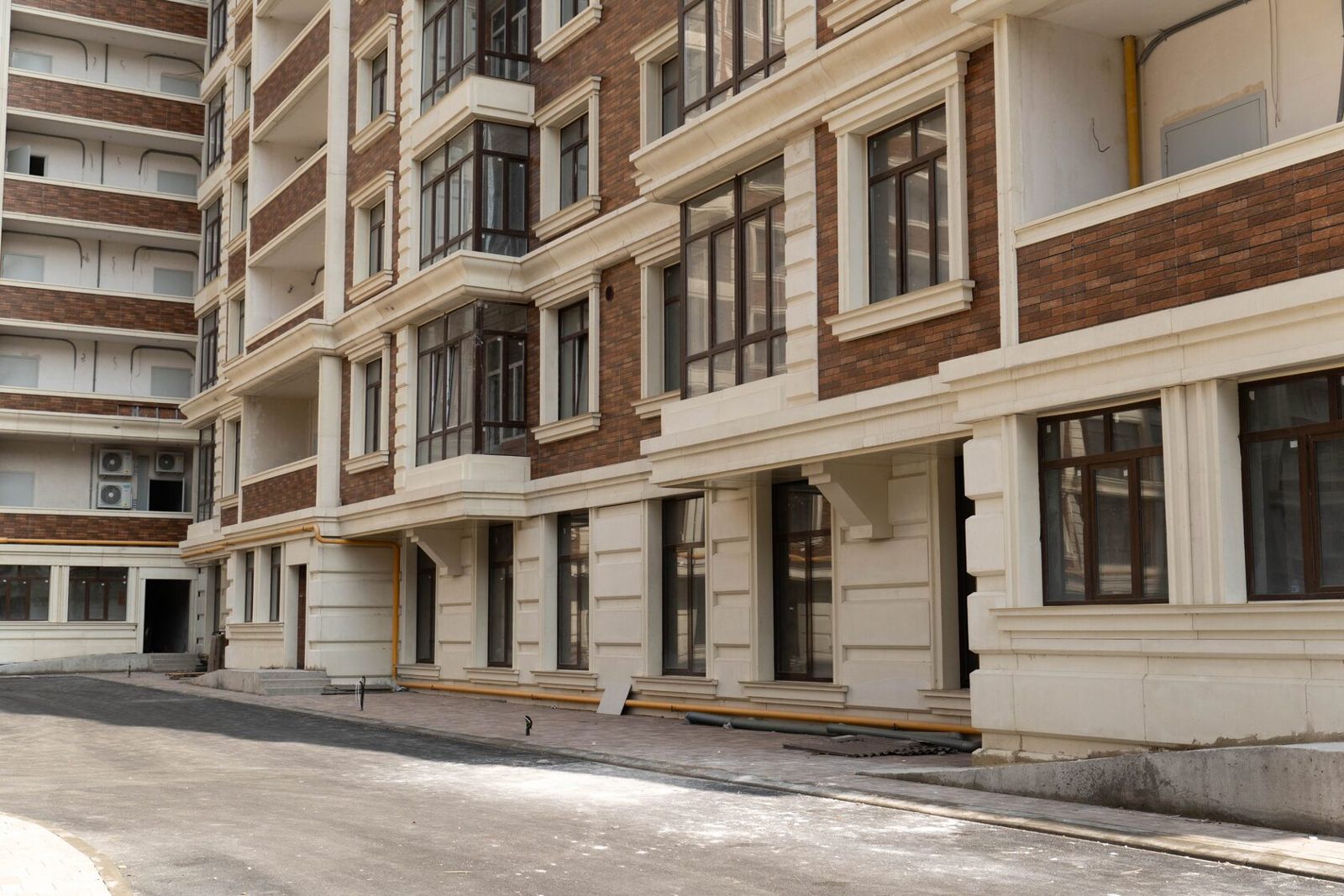
Examples from TECHNOFORMA projects
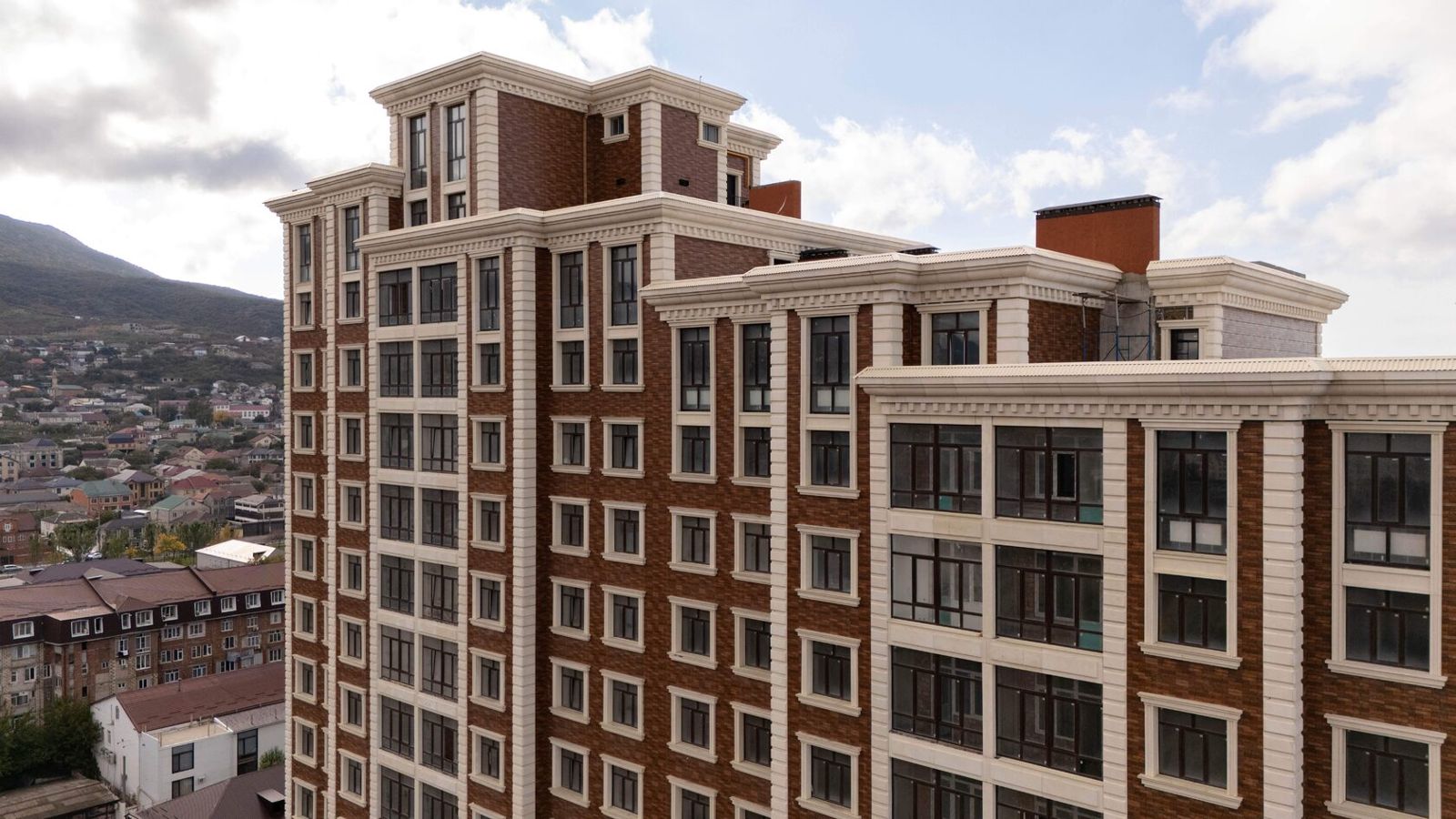
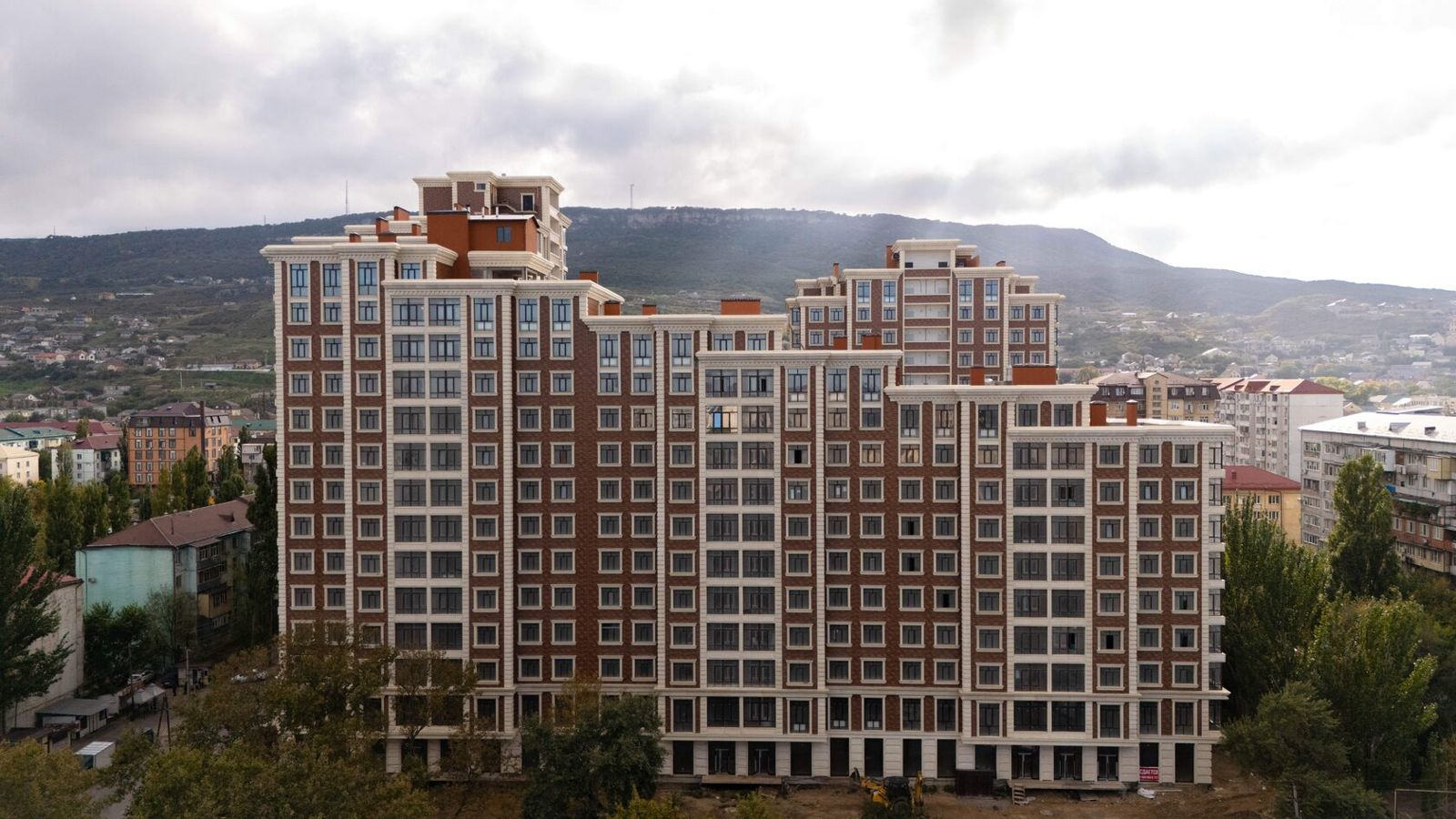
Projects with several years in service show how the material performs in a real climate. The Triumph residential complex in Makhachkala (12 storeys, 11,500 m² of GFRC) was completed in 2021; the Golden Keys residential complex (13 storeys, 12,000 m² of GFRC, three buildings) in 2017. On both, TECHNOFORMA carried out design and installation.
All projects are in the TECHNOFORMA projects section. For the basics of the material, see What GFRC is and where it is used.
FAQ
What is the service life of GFRC?
Decades, with the right mix, design and maintenance; worldwide experience with the material spans more than 50 years.
What does GFRC durability depend on?
On the alkali resistance and content of the fibre, the mix design, element design, drainage, fixings and maintenance.
Does GFRC need water-repellent treatment?
Yes, the impregnation reduces saturation, efflorescence and soiling; it is renewed periodically.
What is GFRC ageing?
A gradual reduction in the ductility of the composite as hydration products fill the fibre strands; it is accounted for in design calculations.
How often should a GFRC facade be inspected?
At least once a year and after strong winds or severe weather.
What shortens the service life of GFRC the most?
Standing water on horizontal faces, rigid fixing without freedom for thermal movement, corrosion of unprotected steel cast-in fixings and lack of regular inspections. Most of these problems originate at the design and production stages.