
Repairing Chips and Cracks in GFRC
Repairing glass fibre reinforced concrete (GFRC) means restoring an element in place: filling chips, blowholes and cracks with repair compounds compatible with GFRC in strength, deformability and colour. It is justified when the defect is local and does not affect the fixing or the load-bearing capacity of the element; otherwise the element is replaced.
The main criterion for choosing between repair and replacement is the cause of the damage. A chip from a scaffold impact can be closed in an hour, whereas a crack caused by a misaligned substructure will reappear after repair unless the fixing itself is corrected. That is why every repair starts with an assessment.
The article is written for maintenance teams, technical supervision and general contractors who accept or maintain facades with GFRC decoration. Related topics: Facade maintenance, standards and repair.
Causes of damage
Damage to GFRC elements is almost always related not to the material itself but to the conditions it works in. Typical causes:
• Mechanical impact — knocks during transport and installation, contact with scaffolding and gondolas, vandalism on lower tiers, hail.
• Restrained thermal movement — if an element is fixed rigidly with no freedom to move, or a movement joint is filled with mortar, stresses and cracks develop as it heats and cools.
• Substructure errors — misaligned rails, too few fixing points, settlement of brackets; the element works in bending it was not designed for.
• Corrosion of cast-in anchors — corrosion products expand and split the concrete around the fixing.
• Wetting and frost damage — water entering through cracks and open pores destroys the surface layer through repeated freezing.
• Shrinkage cracks — a fine network on the surface formed during curing; as a rule, shallow.
The same visible crack can have different causes, so repairs are not prescribed from a photo.
Assessment
The assessment answers three questions: how serious the defect is, whether it is developing and what caused it. The answer determines whether a cosmetic repair is enough.
| Sign | What it usually means | Action |
|---|---|---|
| Chipped edge, blowhole with no cracks around it | Mechanical damage | Repair in place |
| Network of hairline cracks on the surface | Shrinkage, surface stresses | Impregnation, monitoring |
| Single crack from a corner or opening | Stress concentration, restrained movement | Check the fixing, then repair |
| Through crack, displaced parts | Loss of element integrity | Removal and replacement |
| Rust streaks, split near an anchor | Corrosion of the cast-in anchor | Open up the fixing, usually replace |
For the assessment, the crack width is measured with a feeler gauge or crack gauge, and the crack ends are marked with the date — after a few weeks it is clear whether it is growing. Tapping reveals delamination of the face layer (a hollow sound). Fixings are inspected with access to the element; if necessary, an adjacent element is removed.

Repair materials
The repair compound must work together with the element: have similar strength and modulus of elasticity, good adhesion to the substrate and low shrinkage. A material that is too stiff and strong detaches from the GFRC along its edges; one that is too weak crumbles quickly.
• Non-shrink cement-based repair mortars with polymer additives — the main material for chips and blowholes. They come in thin-layer (for levelling) and thick-layer (for rebuilding volume) versions.
• Injection compounds — for filling cracks; the choice between rigid and elastic ones depends on whether the crack is stable or keeps "breathing".
• Elastic sealants — for movement joints and junctions, not for cracks in the body of the element.
• Pigments and finishing compounds — for matching colour and texture; an exact colour match is most often achieved by painting or glazing.
Epoxy fillers are used sparingly: they are strong but not vapour-permeable and differ noticeably in colour and ageing. The specific system is chosen from the mortar manufacturer's technical data sheets, taking into account the layer thickness and service conditions.
Technique
A typical sequence for repairing a chip or blowhole:
1. Preparation. Remove unsound concrete down to a dense substrate, cut the edges to a step rather than feathering them to zero, remove dust.
2. Dampening or priming — as required by the mortar manufacturer, so that the substrate does not draw water out of the mortar.
3. Filling. The mortar is applied in layers of permissible thickness; at large depths, with intermediate strength gain. Templates are used to restore the profile of the decoration, and complex relief is moulded from a cast of an intact element.
4. Curing. Protection from sun, wind and rain, moist curing during the first day.
5. Finishing. Sanding, texture matching, painting with vapour-permeable paint and water-repellent treatment.
Cracks are first chased out or prepared for injection, then filled. Work is carried out at above-zero temperatures within the limits given in the materials' data sheets. The main mistake is repairing the surface without removing the cause: if the crack was caused by an over-tightened fixing or a misaligned rail, the fixing is corrected first.
When to replace an element
Replacing an element is economically and technically justified when repair will not restore its performance or safety:
• a through crack or the element split into pieces;
• damage in the zone of cast-in parts and fixings;
• corrosion of a cast-in anchor with destruction of the concrete around it;
• delamination of the face layer over a large area;
• deformation of the element so that it no longer lines up with its neighbours in plane and joints;
• damage over such an area that the repair would be visible and cost more than a new element.
When replacing, it is important that the new element matches the others in geometry, texture and colour. This is easier if the moulds and working drawings have been kept. On a ventilated rainscreen facade, one element can usually be removed without dismantling its neighbours, but work at height always requires fencing off the danger zone below.
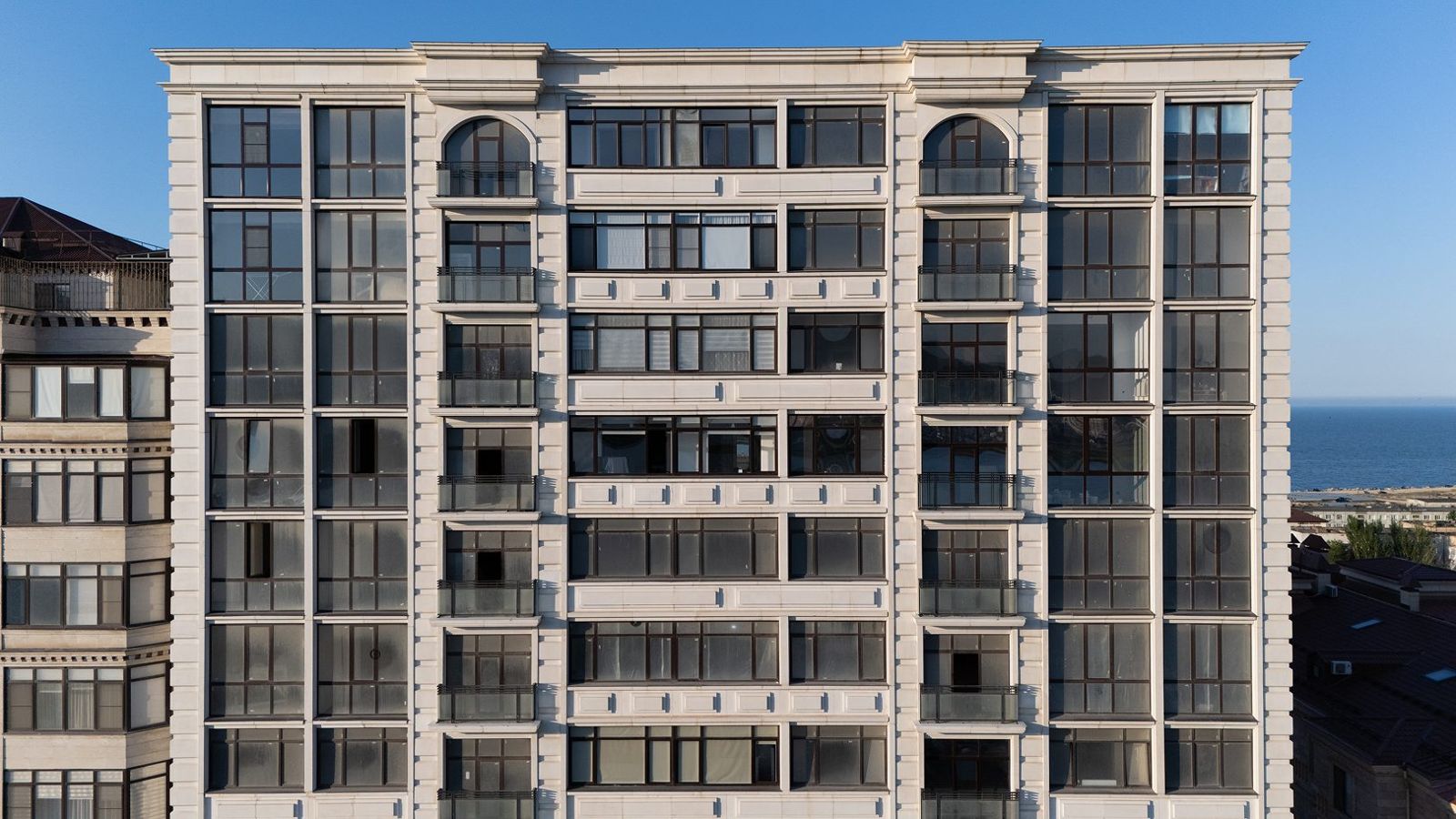
Examples from TECHNOFORMA projects
TECHNOFORMA Group makes models and moulds in its own mould shops, so a replacement element can be produced to the same geometry as during construction. Examples of projects with large volumes of GFRC:
• Anzhi-City residential complex in Makhachkala — 16 storeys, 18,000 m² of GFRC; design and installation.
• Al-Qasr hotel complex in Manas, Republic of Dagestan — 4 eleven-storey buildings, 24,000 m² of GFRC; design and installation.
The full list is under TECHNOFORMA projects. If cracks have appeared not only on the decoration but also on the substrate or other cladding, see Facade cracks: causes and what to do.
FAQ
Are cracks in GFRC dangerous?
A network of hairline surface cracks is usually not dangerous and is closed with impregnation. Through cracks, cracks near fixings and growing cracks are dangerous — they are investigated before repair.
How is a chip in facade decoration repaired?
Remove unsound concrete, dedust and dampen the substrate, fill with non-shrink repair mortar using a template, and after it has gained strength match the texture and colour.
Can a GFRC element be repaired in winter?
Cement-based repair compounds are applied at above-zero temperatures within the limits set by the manufacturer. In winter, temporary measures and repairs inside a heated enclosure are possible.
When is it easier to replace a GFRC element than to repair it?
With a through crack, a split element, damage in the zone of cast-in parts, corrosion of fixings, deformation of the element or a large damaged area.
Will the repaired area differ in colour?
The repair compound is tinted, but an exact match is usually achieved by painting or glazing the repaired area together with the surrounding surface.