Facade Cracks: Causes and What to Do
Cracks on a facade are a sign that stresses in the wall or cladding have exceeded the strength of the material. The causes vary: render shrinkage, thermal movement, corrosion of fixings, foundation settlement. Some cracks are cosmetic, others signal a structural problem, and they can only be told apart by their pattern, location and development over time.
The main rule is to find the cause first and repair second. A crack from settlement or a distorted substructure that is filled without a survey will open again, and it can sometimes mask a dangerous condition of cladding above a pavement.
This guide is useful for building owners and management companies, technical supervisors and maintenance services. Other articles are in the Facade maintenance, regulations and repair section.
Types of cracks
Cracks in building facades are classified by several features, which helps understand their nature even before a survey.
| Feature | Type | Typical meaning |
|---|---|---|
| Width | Hairline (fractions of a millimetre), fine, wide | Hairline cracks are usually superficial; wide ones need a survey |
| Depth | Surface, within the cladding, through the wall | Through cracks affect the structure |
| Pattern | Map cracking, single crack, stepped along masonry joints | Map cracking indicates shrinkage; stepped cracks indicate wall movement |
| Direction | Vertical, horizontal, diagonal | Diagonal cracks at openings and corners often indicate settlement |
| Development | Stable, active | Active cracks are dangerous regardless of width |
Cracks in cladding behave differently depending on the system: on a bonded facade (render, tiles on adhesive) they often follow cracks in the substrate; on a ventilated rainscreen facade the cladding is separated from the wall, and its cracks are usually related to the fixings, impacts or the element itself.
Causes
The main causes of cracks:
• Shrinkage of render, concrete or masonry mortar as it dries. Produces map cracking or single fine cracks, usually stabilises.
• Thermal movement: long stretches of wall and cladding without movement joints, dark facades on the sunny side.
• Settlement and differential movement of the foundation: diagonal cracks from the corners of openings, cracks at the junction of parts of the building of different heights.
• Corrosion of reinforcement in concrete, or of anchors and embeds in cladding; corrosion products split the material.
• Frost damage: water in pores and cracks widens defects through repeated freezing.
• Cladding installation errors: rigid fixing without allowance for movement, too few fixing points, a distorted substructure.
• External actions: impacts, vibration from traffic and nearby construction, seismic activity.
Several causes often act at once: a small shrinkage crack lets water in, and freezing water widens it.
Warning signs
Some signs mean a survey cannot be postponed and access below the facade should be restricted:
• the crack is growing: a mark at its end is inside the crack a few days later;
• the width is noticeably greater than hairline and uneven along the length;
• cladding elements have shifted relative to their neighbours, and the plane or joints are disturbed;
• a hollow sound when tapped, indicating cladding detached from the substrate;
• rust streaks from under slabs, at anchors and brackets;
• cracks at the supports of balconies, canopies and cornices;
• small fragments falling off, debris on the perimeter apron;
• windows and doors sticking at the same time, and cracks appearing indoors.
The last sign points to deformation of the building structure, not just the cladding; this requires assessment by specialists in load-bearing structure surveys.
If detached or shifted cladding is noticed above a pavement, entrance or playground, the first step is not repair but safety: fencing off the danger zone, a protective net or canopy, removing any element that could fall. The owner or management company is responsible for the safe operation of the facade, so these measures are taken immediately, without waiting for a repair design.
Survey
The survey begins with a visual inspection and recording: a facade drawing with the cracks marked, photos referenced to the grid axes, crack width, length and direction. Tell-tales (plaster or plate markers with a date) are fixed across the cracks to see, after a few weeks, whether the defect is growing.
Then, depending on the situation:
• tapping the cladding to find detachment;
• opening up individual rainscreen panels to inspect the substructure and anchors;
• non-destructive testing of concrete strength, rebar location, thermal imaging;
• pull-out testing of anchor capacity.
If deformation of load-bearing structures is suspected, the survey is carried out by specialised organisations in accordance with the Russian rules for surveying the technical condition of buildings. The survey results in a schedule of defects, an assessment of their causes and recommendations: where cosmetic repair is enough, where the fixing details must be corrected, and where the cladding must be replaced or the structure strengthened. Without such a document it is difficult to prepare an accurate estimate and plan the work by sections. More on the procedure in Facade survey: when and how it is carried out.
Tell-tales are usually monitored for several weeks, with their condition recorded in a log with dates and photos. If a tell-tale has broken, the crack is active, and repair without removing the cause is pointless.
Repair
The repair method follows from the cause:
• Shrinkage and hairline cracks: raking out, filling with a repair compound or flexible filler, painting with vapour-permeable paint, water-repellent treatment.
• Cracks in cladding from impacts: local repair of the element or its replacement.
• Cracks from fixings: correcting the detail (loosening rigid fasteners, adding fixing points, realigning rails), then repairing or replacing the element.
• Corrosion cracks: opening up, cleaning or replacing embeds, restoring the concrete cover.
• Cracks from structural deformation: first strengthening or stabilisation according to a design, then finishing repair.
If there are many cracks and the cladding is worn, it is sometimes more rational to replace the whole system, for example with a ventilated rainscreen facade, which separates the cladding from wall movement and allows the building to be insulated. The decision is made based on the survey and a comparison of the costs of the options.
A common mistake is filling a moving crack with rigid cement mortar: it quickly detaches, and the crack reappears next to it.
Examples from TECHNOFORMA projects
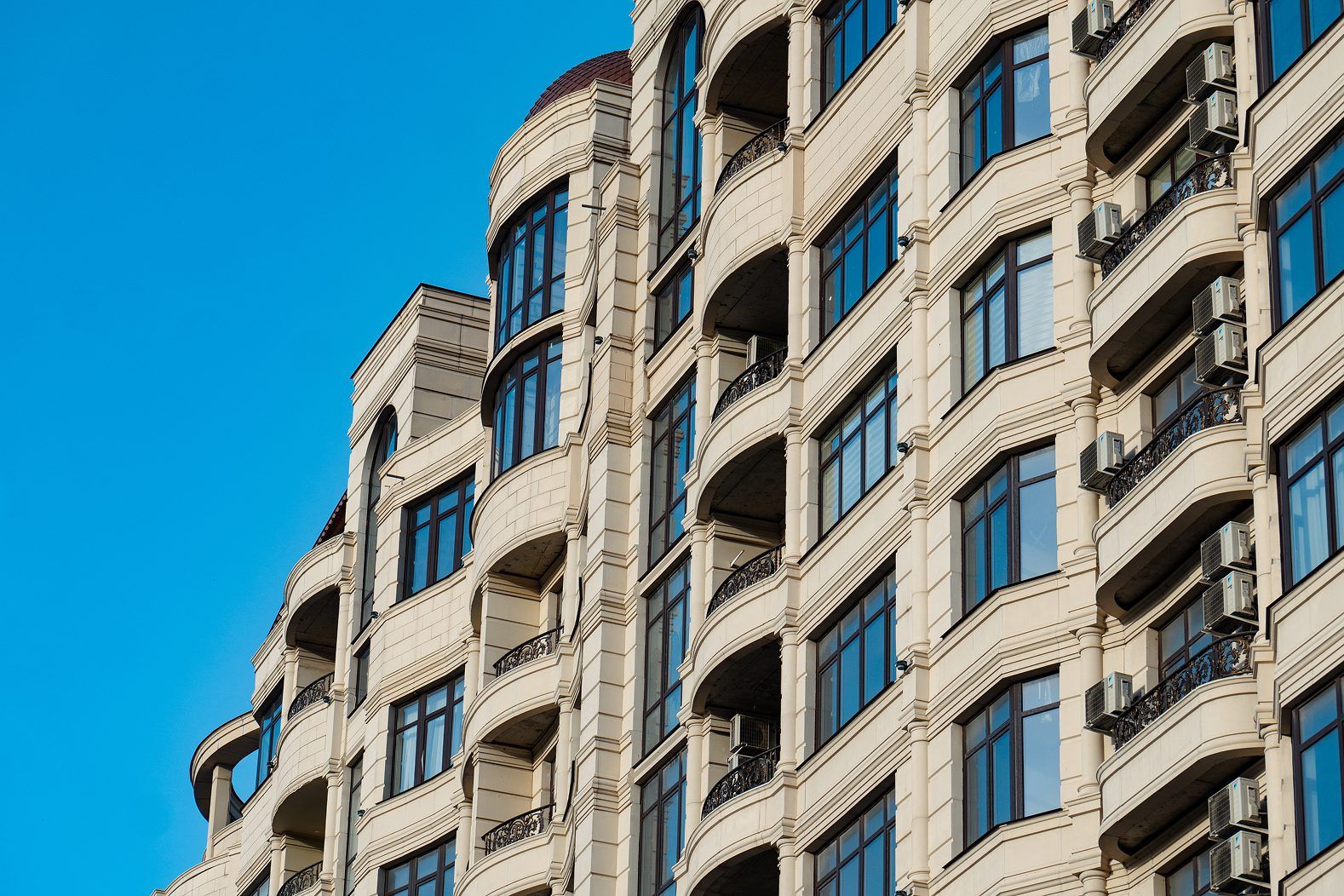
TECHNOFORMA Group provides design, insulation, installation of rainscreen substructures and cladding in GFRC, natural stone and porcelain stoneware. Examples of rainscreen facades with different materials:
• RUBLEVO BUSINESS PARK in Moscow: 2 buildings of 12 storeys, 15,000 m² of GFRC and 5,000 m² of FRONTEK; design and installation.
• Dinastiya club house in Kislovodsk: 6,000 m² of GFRC, 700 m² of porcelain stoneware, 700 m² of granite.
All projects are in the TECHNOFORMA projects section. How to organise a survey before repair is described in Facade survey: when and how it is carried out.
FAQ
Are cracks on a building facade dangerous?
Hairline shrinkage cracks are usually not dangerous. Dangerous ones are growing cracks, cracks with displaced cladding, cracks at anchors and balcony supports, and cracks accompanied by distorted windows and doors.
How can I tell if a crack is growing?
Fix a tell-tale or a dated mark at the ends of the crack and check after a few weeks: if the crack has passed the mark or the tell-tale has broken, it is active.
Why do cracks appear in cladding?
Because of impacts, restrained thermal movement, fixing errors, anchor corrosion, saturation and frost damage, and on bonded systems because of cracks in the substrate.
Can I just fill a crack on the facade?
Only if it is superficial and stable. Otherwise, without removing the cause, the crack will open again, and the filling will hide a dangerous condition of the cladding.
Who should survey the cracks?
Facade specialists for the cladding and substructure; if there are signs of deformation of load-bearing structures, organisations that survey the technical condition of buildings.