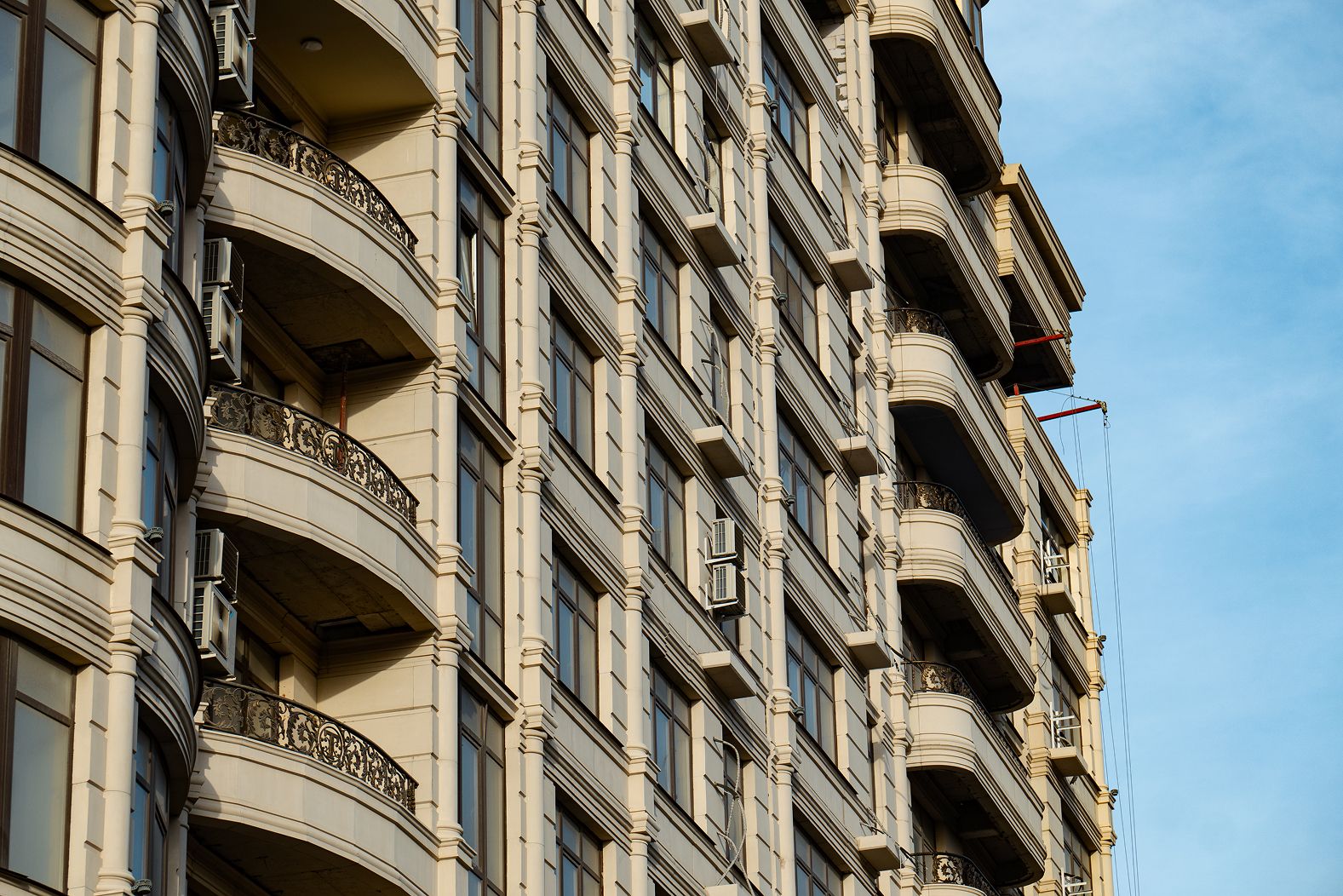
GFRC Care and Maintenance
Caring for glass fibre reinforced concrete (GFRC) comes down to three regular tasks: inspection, gentle cleaning and periodic renewal of the protective impregnation. GFRC is a fine-grained concrete reinforced with alkali-resistant glass fibre; it does not rot or corrode and is classed as non-combustible, so it needs no special care of the kind timber or metal require.
The durability of GFRC decoration and panels depends above all on the condition of the surface layer and the fixing points. If the surface is protected from water saturation and the joints and cast-in anchors are sound, the elements keep their shape and colour for years. The material is chosen by developers and managers of apartment buildings, owners of private houses with facade decoration, and maintenance teams of public buildings.
Below is the maintenance procedure from a GFRC manufacturer. More articles in this section: Facade maintenance, standards and repair.
Regular inspection
Inspection is the basis of maintenance: most problems on a GFRC facade are cheaper to fix at an early stage than after a winter of freeze–thaw cycles. A practical routine is a scheduled inspection in spring and autumn, plus an unscheduled one after strong wind, hail, an earthquake, a fire nearby or repair work on adjacent structures.
What to check during an inspection:
• Element surfaces — hairline and through cracks, chipped edges, delamination of the decorative layer, efflorescence, leak stains.
• Joints — integrity of the sealant, separation from the edges, cracks, plants growing in the joints.
• Fixing points — visible cast-in anchors and brackets, traces of rust, streaks below anchors, displacement of elements relative to their neighbours.
• Drainage — sills, parapet cappings, cornices: water should not run down the face in a constant stream.
• Junctions — windows, balconies, roof, where wetting most often occurs.
It is convenient to record the results with photos referenced to the building's gridlines and levels. Repeated photos from the same points show whether a defect is developing. Lower tiers are inspected from the ground and ladders, upper tiers from an aerial platform, a gondola or by rope-access technicians; binoculars help to find suspicious areas but do not replace a close inspection of the fixings.
Cleaning
GFRC needs cleaning when dirt spoils its appearance or retains moisture: urban dust and soot, streaks from metal elements, biological growth on north-facing sides, efflorescence. The rule is to start with the gentlest method and move to a more aggressive one only if the first does not work.
1. Low-pressure water and a soft brush — for dust and fresh dirt. Suitable for any element, including decoration with fine relief.
2. Neutral detergents (pH around 7) — for greasy soot and deposits; after treatment the surface is rinsed with clean water.
3. Special products — for efflorescence, rust, moss and lichen. They are chosen for the type of contamination and tested on an inconspicuous area.
What to avoid: concentrated acids (they dissolve the cement matrix and open the pores), stiff wire brushes, abrasive blasting and high-pressure washing at close range — all of these destroy the face layer, after which the element absorbs water and dirt faster. Painted and textured surfaces are cleaned with particular care. Work is carried out at above-zero temperatures so that the water can evaporate before night frosts.

Water-repellent treatment
Water-repellent (hydrophobic) treatment is an impregnation that reduces the capillary water absorption of the surface while keeping it vapour-permeable. For GFRC this is an important measure: less water in the pores means less frost damage, less efflorescence and biological growth, and dirt sticks less and is washed off more easily by rain.
Silane and siloxane impregnations are normally used; they penetrate the surface layer and do not form a film. The procedure:
• clean and dry the surface — impregnation works worse on wet concrete;
• repair cracks and chips before impregnating, otherwise water will get in around the protection;
• apply the product according to the manufacturer's method — as a rule, "wet on wet" until saturation;
• check the effect: water on the treated surface should bead up.
How long the impregnation lasts depends on the product, the facade orientation and the climate; the reference is the impregnation manufacturer's instructions and a simple water test. When droplets no longer bead and the surface darkens in rain, the treatment is repeated. If the elements are painted with facade paint, check in advance that the impregnation is compatible with the paint.
Painting
GFRC elements are often left in their through-body colour — the pigment is added to the concrete during manufacture, and such colour does not peel. Painting is needed when the design calls for an exact colour, to even out shades after repair, or when refreshing the facade.
Painting requirements:
• Vapour permeability. Use facade paints for mineral substrates — silicate, silicone or vapour-permeable acrylic. Dense film-forming coatings trap moisture, and the coating peels off in blisters.
• Preparation. The surface is cleaned, dedusted, efflorescence is removed, and if necessary it is primed with a primer from the same system as the paint.
• Conditions. Dry weather, substrate and air temperature within the limits specified by the paint manufacturer; do not paint over fresh repair mortar before it has gained strength.
• Compatibility. Repainting is done with the same system, or the adhesion of the new coat to the old one is checked on a trial area.
How often to repaint depends on the condition of the coating: fading, chalking and peeling are signs that the coat needs renewing.
Minor repairs
Minor repair means eliminating local defects that do not affect the load-bearing capacity of the element: chipped edges, blowholes, hairline cracks, a failed section of sealant in a joint. The sooner a defect is closed, the less water gets inside and the lower the risk that it grows over the winter.
• Chips and blowholes are filled with concrete repair mortars compatible with GFRC in strength and colour: the surface is cleaned, dampened, primed if necessary, filled and the relief is shaped.
• Hairline cracks are usually not dangerous; they are treated with impregnation or elastic compounds to prevent wetting.
• Joints — the failed sealant is removed and restored using the same system.
If a crack is open, runs through the element, the element has shifted or there are signs of corrosion of the fixing, this is no longer a minor repair. Such an element is inspected and a decision is made whether to repair or replace it. The technique is covered in detail in Repairing chips and cracks in GFRC.

Examples from TECHNOFORMA projects
TECHNOFORMA Group designs, manufactures and installs GFRC facades, so the composition of the elements and the fixing details on its projects are known in advance — which makes maintenance easier. Examples with large volumes of GFRC:
• Dominanta residential complex in Makhachkala — 18 storeys, 4 buildings, 14,000 m² of GFRC combined with 13,000 m² of porcelain stoneware; design and installation.
• Dubai Houses residential complex in Grozny — 30 nine-storey buildings, 70,000 m² of GFRC; design and installation.
Other projects are listed under TECHNOFORMA projects. If the inspection revealed chips or cracks, continue with Repairing chips and cracks in GFRC.
FAQ
How often should a GFRC facade be inspected?
A practical routine is a scheduled inspection in spring and autumn, plus an unscheduled one after strong wind, hail or work on adjacent structures. Results are recorded in photos referenced to the building gridlines.
What should GFRC be washed with?
First low-pressure water and a soft brush, then neutral detergents. Concentrated acids, wire brushes and abrasive blasting destroy the face layer.
Do GFRC elements need water-repellent treatment?
It is advisable: a silane-siloxane impregnation reduces surface water absorption, cuts efflorescence and deposits and keeps the surface vapour-permeable. It is repeated when water no longer beads up.
Can GFRC decoration be repainted?
Yes, with vapour-permeable facade paints for mineral substrates after cleaning and priming. Dense film-forming coatings should not be used.
What should be done about a chip in GFRC decoration?
A small chip is filled with a compatible repair mortar. If the crack runs through, the element has shifted or the fixing shows rust, the element must be inspected and replacement considered.