Water Absorption of Facade Materials and Why It Matters
The water absorption of stone is the amount of water a material takes up when saturated, expressed as a percentage of the dry specimen's mass. The indicator is directly related to porosity and determines how vulnerable stone or concrete on a facade is to frost, efflorescence, dirt and biological growth.
The main selection criterion: the higher the water absorption, the stricter the requirements for frost resistance, zone of use and protection of the material. Dense granite with water absorption of a fraction of a percent can be used on plinths and steps, while porous shell limestone needs sheltered zones and water-repellent treatment.
The article is written for architects, designers, technical supervision and clients choosing cladding. Related articles: Facade maintenance, standards and repair.
The indicator
Water absorption by mass is defined as the ratio of the mass of absorbed water to the mass of the dry specimen, in percent. Water absorption by volume — the ratio of the volume of water to the volume of the specimen — is sometimes used; it is closer to open porosity.
What the indicator says about the material:
• Open porosity — the share of pores connected to the surface; this is how water enters the material.
• Tendency to soil — a porous surface absorbs not only water but also dissolved dirt, oils and salts.
• Risk of efflorescence — water carries salts to the surface, where they crystallise.
• Frost damage — saturated pores break down when they freeze.
• Thermal performance — a wet material conducts heat better than a dry one.
Capillary water absorption — the rate at which water is drawn in through the surface — is considered separately. For a facade it is even more telling: rain does not immerse the cladding but wets it, and what matters is how quickly the moisture moves inwards.
Link to frost resistance
The link between water absorption and frost resistance is direct but not linear. It is not the water itself that destroys the material, but ice in pores filled with water beyond a certain share of their volume: when there is no free space left for the ice to expand, stresses arise.
• Materials with low water absorption (dense granite, basalt, porcelain stoneware) rarely become saturated to a critical level and usually have high frost resistance.
• Porous materials can be frost resistant if the pores are large and interconnected or if the structure contains reserve pores that do not fill with water. This is the basis of air entrainment in concrete: small closed air pores act as "expansion chambers" for the ice.
• The same water absorption in two stones does not guarantee the same frost resistance — pore size and shape, the strength of the skeleton and fissuring all matter.
So water absorption is a filter for initial screening, but the decisive indicator for a facade is the frost resistance grade confirmed by testing.
Materials
Indicative water absorption values for facade materials; exact data depend on the quarry, mix design and technology and are given in the product data sheet or test report.
| Material | Water absorption by mass (guide) | Application notes |
|---|---|---|
| Granite, basalt | Fractions of a percent | Plinths, steps, paving, any facade zone |
| Porcelain stoneware | Less than 0.5% | Ventilated facades, plinths |
| Marble | Fractions of a percent to about 1% | Wall cladding; outdoors the stone type and surface finish matter |
| Dense limestone, dolomite, travertine | From fractions of a percent to several percent | Walls, decoration; choose by quarry |
| Sandstone | Wide range, from a few percent | Depends on the cementing material of the stone |
| Shell limestone (coquina), porous limestone | High, may exceed 10% | Sheltered zones, water-repellent treatment essential |
| Normal-weight concrete, GFRC | A few percent | Depends on water–cement ratio, compaction, admixtures |
For concrete and GFRC, water absorption is reduced by designing a mix with a low water–cement ratio, good compaction and proper curing.
Protection
There are three ways to reduce the effect of water on cladding.
1. Choosing the material for the zone. For plinths, parapets, steps and horizontal elements — materials with low water absorption. Porous stones — on vertical sheltered surfaces.
2. Design protection. Sills and cornices with drips, falls on horizontal surfaces, sound drainage, a capillary break from the ground at the plinth, a ventilated cavity behind the cladding that lets it dry.
3. Water-repellent treatment. Silane-siloxane impregnations penetrate the pores and make their walls water-repellent without closing the pores, keeping vapour permeability. Capillary water absorption falls markedly. Film-forming varnishes are not recommended for facade stone and concrete: they trap moisture, and the coating peels.
Before impregnation the surface is cleaned and dried and cracks are filled. The effect is checked by simple wetting: water on a protected surface beads up. When the effect wears off, the treatment is repeated.
Testing
How to test water absorption:
• In the laboratory. Specimens are dried to constant mass, saturated with water and weighed. For concrete, the method is set by the Russian standard GOST 12730.3 "Concretes. Method of determination of water absorption". For natural stone, cladding stone test methods are used.
• From documents. Ask the supplier for a test report for the specific quarry or mix design, not general reference figures for the "stone type in general".
• On site. A simple test: a drop of water on the surface. If it soaks in within seconds and the surface darkens, the material actively absorbs water. For a quantitative on-site assessment of capillary absorption, a Karsten tube is used — a graduated glass tube attached to the surface; the rate at which the water level drops shows the absorption and the effectiveness of the impregnation.
It is useful to do the on-site test before and after water-repellent treatment, and then during scheduled inspections — this shows when the protection needs renewing.
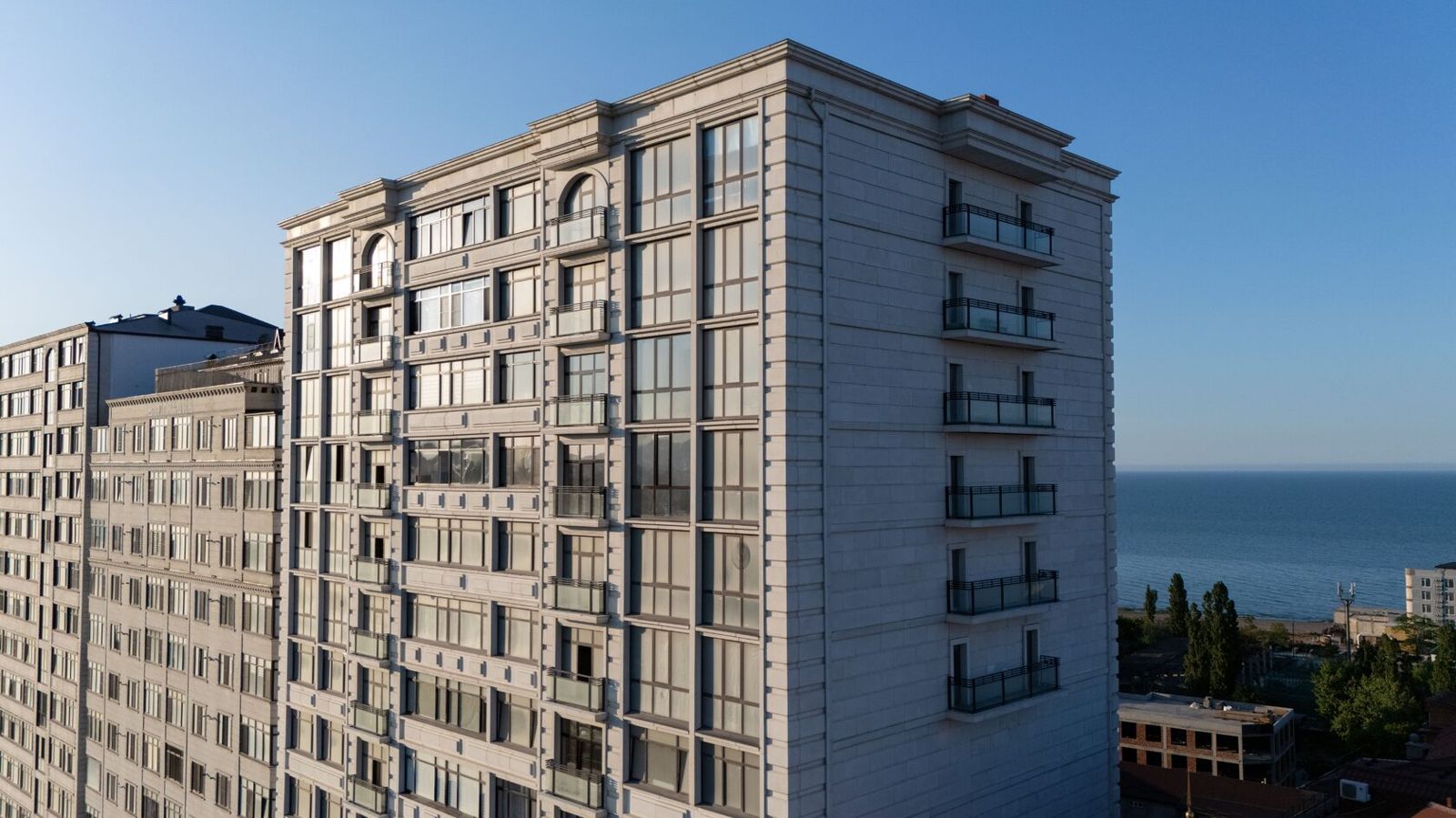
Examples from TECHNOFORMA projects
TECHNOFORMA Group supplies natural stone of various types — granite, basalt, marble, limestone, dolomite, sandstone, travertine, shell limestone, onyx — and manufactures GFRC elements. The company's equipment processes both soft stones (sandstone, shell limestone, dolomite, limestone) and hard ones. Examples of projects:
• Dinastia club house in Kislovodsk — 700 m² of granite, 700 m² of porcelain stoneware and 6,000 m² of GFRC.
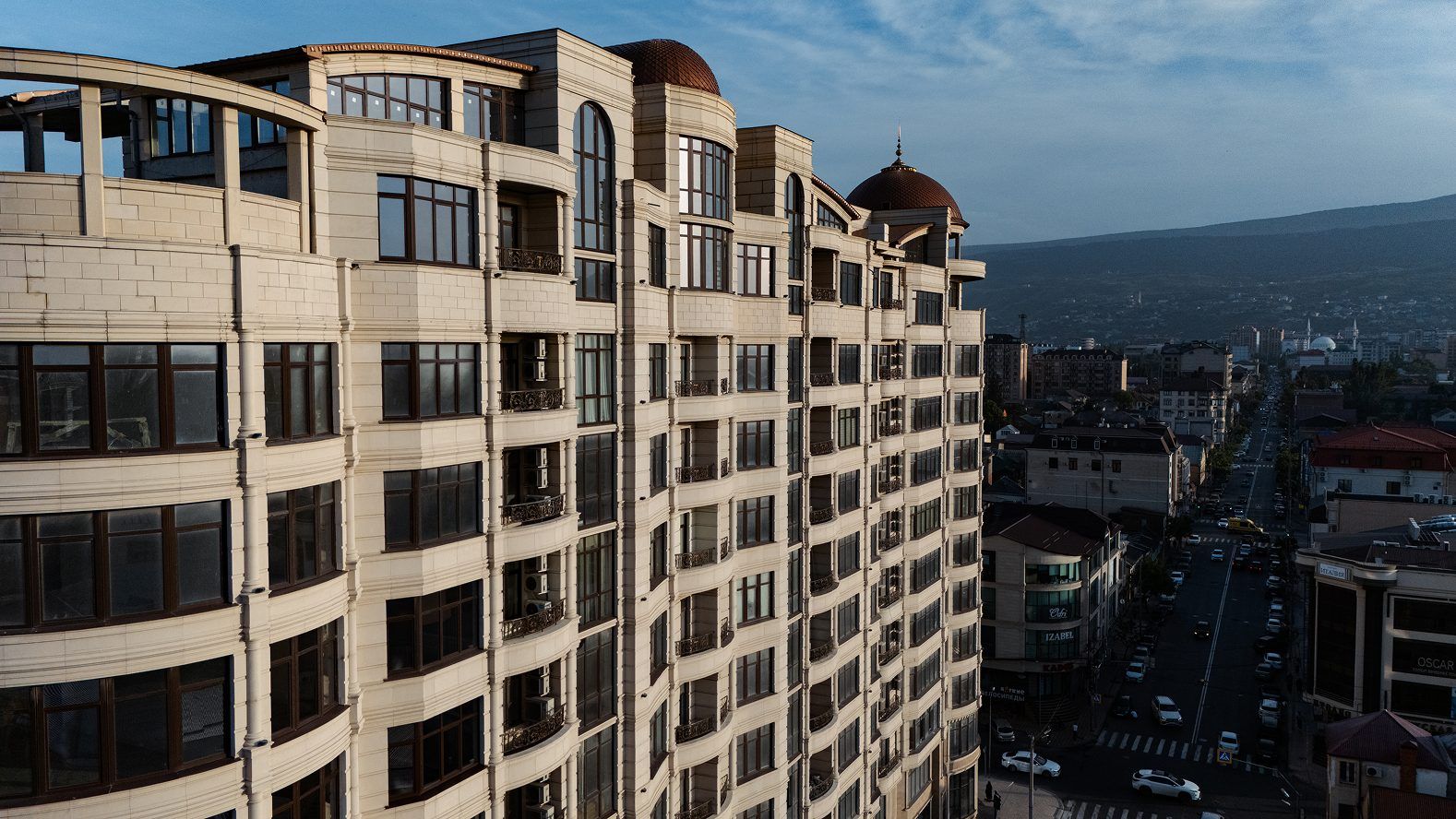
• Dominanta residential complex in Makhachkala — 14,000 m² of GFRC and 13,000 m² of porcelain stoneware.
All projects are under TECHNOFORMA projects. Who is responsible for the cladding after handover is discussed in Facade warranty: what it covers and how it is documented.
FAQ
What is the water absorption of concrete?
Usually a few percent by mass; the exact value depends on the water–cement ratio, compaction, admixtures and curing. The test method is the Russian standard GOST 12730.3.
Which stone absorbs the least water?
Dense igneous stones — granite and basalt, with water absorption of fractions of a percent. The highest is in shell limestone and porous limestones.
How does water absorption affect frost resistance?
The more water in the pores, the higher the risk of damage on freezing. But the decisive indicator is the frost resistance grade confirmed by testing, not water absorption alone.
How can the water absorption of a facade be reduced?
Choose the material for the facade zone, provide drainage and a ventilated cavity, and apply a vapour-permeable silane-siloxane water-repellent impregnation.
How can stone water absorption be checked on site?
With a drop of water or a Karsten tube: the rate of absorption shows the capillary water uptake and the effectiveness of the impregnation.